OTA vs Direct Booking: A Thorough Comparison to Help You Make a Smart Choice.
Most hotels treat OTAs as a default, not a decision. This article breaks down what that approach costs you and when it makes sense to change it.
High occupancy does not always ensure high profit. Most hotel owners eventually have to deal with this reality.
The way you book a hotel or resort is a big part of the difference between what revenue it makes and what profit it keeps. Platforms like Booking.com, Expedia, and Agoda have made it genuinely easier to reach guests at scale. But that convenience comes at a cost, and for many hotels, that cost goes up month after month in the form of commissions.
The point of this article is not to discredit OTAs. They really do serve a real purpose. "When should you use OTAs and when should you take back control with an in-house direct booking system?" is the most important question.
What's the Difference?
OTAs are third party websites that show your property next to thousands of others. They do the marketing, finding, and even the payment processing in exchange for a cut of each booking. Some popular sites in this industry are Booking.com, Expedia, Agoda, or Airbnb for short-term rentals.
A direct booking engine, on the other hand, is a tool that you put on your own website that lets guests check availability, choose room types, and do the payment all without leaving your site. You are in charge of the whole guest relationship and transaction.
Why Hotels Use OTAs (And Why It Makes Sense)
The fact is that OTAs are genuinely powerful in terms of generating positive results.
They bring unmatched global reach. A small boutique hotel in Bali or in Rajasthan can now get guests from anywhere in the world without spending any money on international advertising.
OTAs also transfer trust. Millions of people who travel depend on the ratings, reviews, and familiar interfaces of the platforms they already use. Being listed on a trusted OTA is like borrowing credibility for a new or less well-known hotel.
They generate demand that you might not have been able to get otherwise, especially during off-peak season or when you're entering a new market.
OTAs are a great way to get new customers. But they are also very expensive.
The Hidden Cost of OTA Dependency
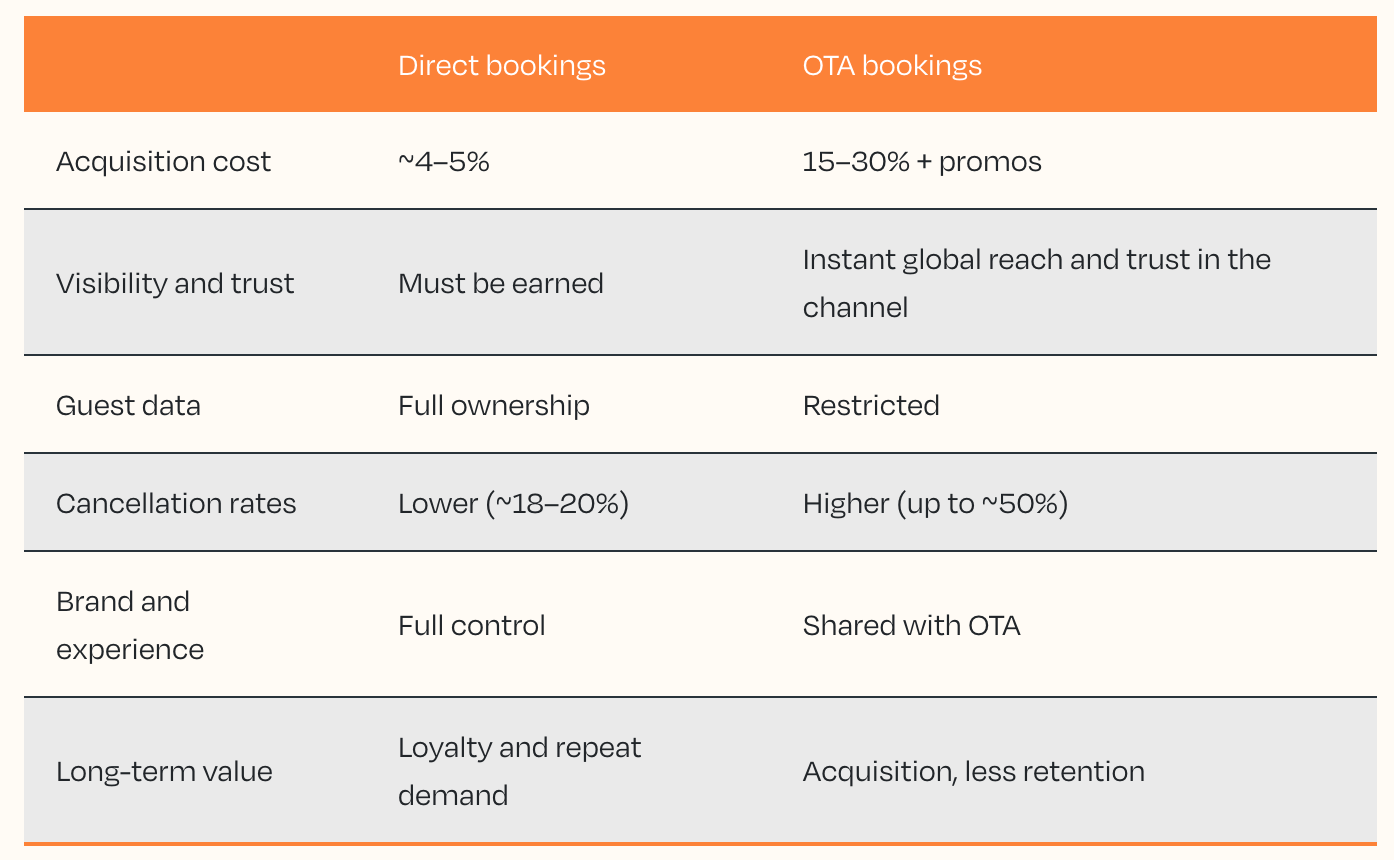
Most well-known OTAs charge independent hotels a commission of between 15% to 30% per booking. Larger chains can usually get better rates, often 10–15%, but individual or boutique properties can't.
According to a cost analysis by Thrivin Digital, a $500 room booked through an OTA only brings in 82.7% of the money, while a direct booking brings in 93.2%.
For instance, a $100 booking for a standard room becomes about $70 to $75 after deducting the OTA commission. When you multiply that by 200 rooms a month, the number starts to hurt.
But the financial loss is only one part of the problem.
You don't own the guest. OTAs get to keep the customer data. You only get a booking name and a check-in date. No email address for remarketing. No preference history. No way to build loyalty.
OTAs also show your property next to those of your direct competitors, which is even worse. A guest can see 12 other options in the same price range on the same screen as your listing. You always have to compete on price, which makes you want to lower your prices, which affects your brand value over time.
The OTA bookings have a cancellation rate of almost 50%, while direct bookings have a rate of only 18.2%. That's an operational challenge on top of a financial one.
What Is a Direct Booking Engine?
Software that manages the entire reservation process from date selection, room type, pricing, and safe payment is incorporated into your hotel's website as a direct booking engine.
Independent and mid-sized hotels frequently use tools like Cloudbeds, SiteMinder, and RMS Cloud. They give you total control over the booking process, connect to your payment gateway, and coordinate inventory across channels via a channel manager.
There is more to the business value than just commission savings. It's in taking ownership of your guest's relationship, data, and conversation from the very beginning.
When to Use a Direct Booking Engine
This is the core of it. Knowing when to lean on your direct channel is smart revenue strategy.
Repeat and Returning Guests
A guest who has previously stayed with you already has faith in you. OTA validation is no longer required for them. They want an excuse to return right away. With no commission, significantly lower cancellation rates, and a guest who already knows what to expect, this is your highest-margin opportunity. Giving the customer a small perk, such as an early check-in, a room upgrade, or a loyalty discount, facilitates their decision-making.
Branded Search Traffic
When someone types your hotel's name directly into Google, they already know who you are. Their intentions are clear. They're not browsing. They are just one step away from making a reservation. If that search leads them to your OTA listing instead of your website, you just paid a commission for a guest who was already coming to you.
Strategy: Invest in basic search engine optimisation for your brand name or Google Hotel Ads. Use your own booking engine to find those visitors before OTAs do.
Peak Season and High-Demand Periods
You don't need OTAs to drive bookings when demand is already high and your calendar is filling up fast. In any case, the guests will arrive. Now is the perfect time to increase availability through your direct channel and decrease your OTA inventory allocation. You maintain the same level of occupancy, retain a larger portion of the earnings, and establish a closer relationship with the guest.
Niche and Boutique Hotels
Your experience sells itself if your property offers something truly unique, such as a remote eco-lodge, a heritage haveli, or an innovative urban stay. Visitors who are looking for that level of detail are not merely perusing; they are actively conducting research. Introduce yourself to them on your website and tell them that story more effectively than any OTA listing could.
Loyalty and Long-Stay Guests
Your direct channel allows you to provide genuine value, such as a free night, a complimentary breakfast, room preference priority, an upgrade or a dedicated contact, to guests who are booking longer stays or coming back for the second or third time. OTAs do not allow for these touches. They create the kind of guest equity that keeps your schedule full without requiring you to pay each time.
When OTAs Still Make Sense
Here, it's important to have a balanced perspective, so let's be clear: OTAs still have a valid role to play.
OTAs are how and where people find you if you're a new property without a well-established online presence. OTA visibility is a real benefit if you're trying to reach a guest segment you've never reached before or are entering a new geographic market.
OTAs can create the occupancy that is necessary to maintain operations during low season, when demand is weak and volume is required.
The Smart choice: A Hybrid Model
The most profitable hotels don't strictly choose one between OTAs and direct bookings. They use both, strategically.
Think of it this way:
- OTAs handle acquisition. They introduce guests to your property.
- Your direct channel handles profitability. This is where you retain margin and build loyalty.
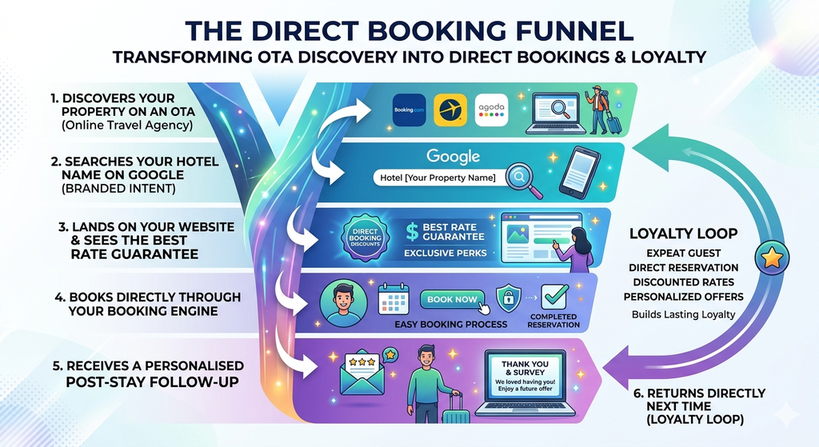
Here's how the guest journey can work in your favour:
The Direct Booking Funnel -
Conclusion
Financial analysis highlights a compelling insight: direct bookings generate nearly 18% higher profitability when ancillary spending is factored in. Meanwhile, OTAs, despite their massive $14 billion marketing spend and a decline in bookings from 39% to 34%, reveal a growing preference for direct channels among travellers.
It is about how much control you want over your brand story, guest relationships, and revenue. You can reach them with OTAs. You gain control with a direct booking engine.
Striking the optimal balance between direct and indirect business sources will ultimately result in a hotel enjoying higher profit contribution, delivering better consumer experiences through higher levels of guest engagement, and yielding healthier economics for a hotel as a result of a diverse business base.