System-to-System Data Syncing
Your CRM, inventory, finance, and support tools kept in sync automatically, including systems like our ERP business software, so nobody's re-entering the same customer or order record in three different places.
AI Integration
Most businesses aren't short on data. They're short of a way to get it moving between the systems that need it. Canduit builds AI data integration that pulls your tools into one working system, so information updates itself across platforms instead of someone copying numbers every morning.
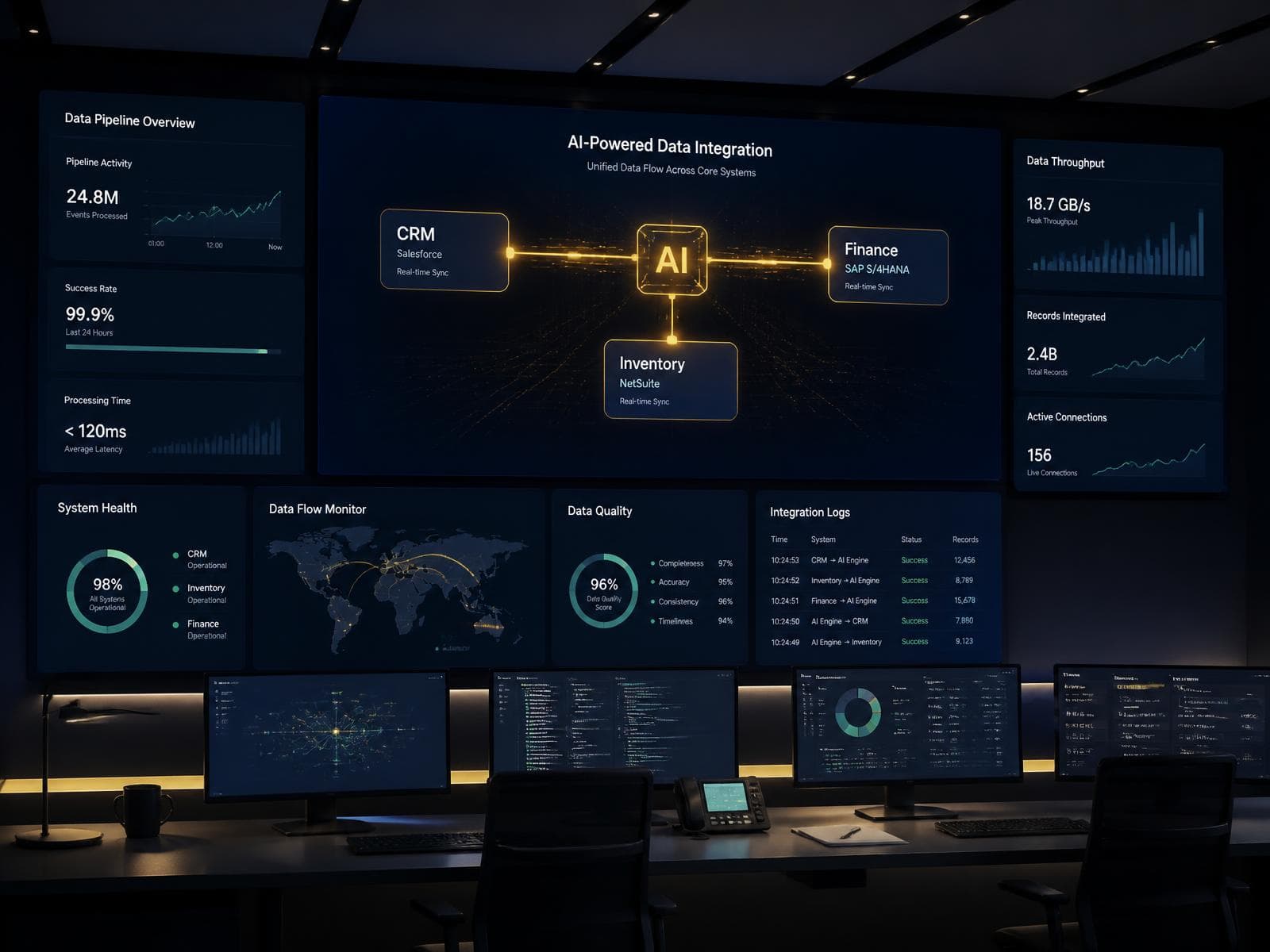
Your systems talking to each other, so your team doesn't have to bridge the gap by hand.
AI data integration connects the software your business already runs, CRM, inventory, finance, support, and uses AI to move, clean, and act on that data automatically. Instead of a person exporting a spreadsheet from one tool and uploading it to another, the systems talk directly and the AI handles the parts that used to need a human checking for errors.
Canduit builds this as an AI integration platform tailored to your actual tech stack, not a generic connector that only handles the easy cases and leaves the messy ones for your team to fix by hand.
A lot of AI integration projects turn into months of strategy decks before anything actually gets built. Big workshops. A roadmap nobody executes. By the time the recommendations arrive, the business problem has usually changed.
Canduit skips the theater. We look at your systems, find where data is getting stuck or duplicated, and build the automated data integration that fixes it, with something working in weeks, not a slide deck in six months.

No forcing a rip-and-replace of software your team already knows how to use.

You see data flowing between systems within the first phase, not just a proposed architecture diagram.

We start with the manual data work costing your team the most hours, not a generic feature list.
Connecting systems intelligently takes more than an API call. Here's what's built into a Canduit AI integration project.
Your CRM, inventory, finance, and support tools kept in sync automatically, including systems like our ERP business software, so nobody's re-entering the same customer or order record in three different places.
Duplicate records, inconsistent formatting, and missing fields get flagged and corrected automatically, instead of surfacing as a mess someone finds during quarterly reporting.
Where a native integration doesn't exist, we build the connection ourselves, tailored to how your systems actually structure their data.
Beyond just moving data, AI models trained on your business patterns to flag trends, forecast demand, or catch anomalies before they turn into a bigger problem.
Approvals, alerts, and routine decisions handled automatically based on the data flowing through your systems. This is the same engine behind our Yarden AI product, adapted to your specific workflows.
Data pulled live from every connected system into one dashboard, so leadership isn't waiting on someone to manually compile numbers from four different tools.
Here's what tends to change once your systems are actually talking to each other.
Less time spent copying numbers between spreadsheets and platforms that should already be synced.
Automated validation catches mistakes before they turn into a wrong invoice, an overselling problem, or a bad forecast.
Real-time dashboards replace the monthly scramble to pull numbers together from disconnected systems.
Patterns and forecasts surface automatically instead of getting missed in a spreadsheet nobody had time to analyze.
No more manually bridging the gap between tools that were never built to talk to each other in the first place.
Built to expand as your business adds new software, instead of requiring a fresh integration project every time.

One connected system across sales, operations, and finance.

The more tools a business runs, a CRM here, an inventory system there, a separate finance platform, the more places data can get out of sync. Growing businesses feel this first in the reporting gaps: numbers that don't match depending on which system you pull them from.
Canduit builds data integration automation for businesses juggling multiple platforms across sales, operations, and finance. If your stack includes an online storefront, our e-commerce development team connects order and inventory data directly into the integration. If it includes custom internal tools, our web app development team builds the dashboards your staff actually use to see it all in one place.
Here's what a Canduit AI integration project looks like, from the first conversation to a fully connected system.
We map out every system you currently run and identify where data is duplicated, delayed, or falling through the cracks between tools.
A closer look at data quality and structure across your systems, so we know exactly what needs cleaning before automation goes live on top of it.
We design the connections and automation rules around your actual workflows, deciding what runs automatically versus what still needs a human check.
Our team builds the integrations and AI models in phases, testing each connection against real data before moving to the next. Where infrastructure needs to scale alongside the integration, we coordinate through our DevOps practices.
We roll out integrations in stages, starting with the highest-impact connections, so your team adapts without operations grinding to a halt.
Support doesn't end at go-live. You get a plan for monitoring data accuracy, tuning models, and adding new integrations as your systems change.
We could tell you why Canduit is worth working with. We'd rather let the people who've actually gone through a project with us tell you instead.

10 months ago
I recently took a subscription of Canduit’s ERPfy, and its usefulness has surpassed my expectations. The team was super attentive to all my customization requests and even suggested a few small tweaks that made the system run even more effective for my startup. They also provided clear, helpful tutorials that made it easy to get comfortable with the already user-friendly interface of ERPfy. Overall, great experience and most importantly, no one else offered such a good quality ERP package at such a good price.

10 months ago
My business was in chaos. Got a good erp for my business from them. Satisfied with their after sales service.

10 months ago
I contacted them to develop an e-commerce website for my business. Happy with their service so far.

a week ago
As the Supply Chain Manager at Cowbell Group, I highly recommend Canduit Software Services. They provided us with a robust ERP solution tailored to our supply chain operations, and it has made a significant difference in how we manage procurement, inventory, and vendor coordination.

Not another consultancy that hands you a strategy document and disappears.

We implement the integration ourselves. You get a working system, not a recommendation report someone else has to execute.

Integrations built around your existing software stack, not a push to replace tools that are already working fine for your team.

A written scope and realistic timeline laid out on your first call through our contact page. Not an open-ended engagement billed by the hour.

AI integration, ERP, and custom software handled by teams that already work together, so your integration isn't stuck waiting on a separate vendor.

Ongoing monitoring, model tuning, and new integrations included after deployment, not a handoff the moment the system goes live.
Whether your team is drowning in manual data entry or just tired of numbers that don't match across platforms, Canduit can build the AI data integration that fixes it. Learn more about our team on the about page, or book a free consultation to walk through your systems.
AI data integration connects the different software systems a business runs, then uses AI to clean, sync, and act on that data automatically. Instead of someone manually moving information between tools, the systems share data directly and AI handles tasks like flagging errors or spotting trends in real time.
Standard data integrating tools move data from one place to another on a schedule. Adding AI on top means the system also cleans inconsistencies, flags anomalies, and can make routine decisions automatically, rather than just transporting raw data for someone to sort through later.
Cost depends on how many systems need to be connected, how messy the existing data is, and how much automation you want built on top of the integration. We provide a specific quote after a discovery call, based on your actual systems, not a flat industry rate.
In most cases, yes. Canduit builds custom connections for platforms that don't already have a native integration available, so you're not required to switch tools just to get them talking to each other.
A single high-impact integration can be live in a few weeks. A full data integration automation project across several systems typically takes a couple of months, depending on data quality and how many workflows need to be automated.
Yes. Data is encrypted in transit and at rest, and access is controlled by role, so only the systems and people who need specific data can reach it. Security is planned into the integration architecture from the start, not added on afterward.
Yes. Once your data is connected and clean, AI models can be trained on it to forecast demand, flag unusual patterns, or predict things like inventory shortages before they happen. That predictive layer is usually the second phase, built once the underlying integration is solid.

Canduit is a dynamic software company specializing in enterprise solutions like ERP, CRM, and HRMS, as well as custom software development, designed to simplify and empower businesses.


Copyright © 2026 Canduit. All rights Reserved
