PMS vs Channel Manager vs Booking Engine: Why Hotels Need All Three
Learn the integration of systems responsible for effortless hotel booking.
.png&w=3840&q=75)
Modern hotel management depends on three core technology systems. They are a property management system, a channel manager, and a booking engine. Most hotel managers have encountered all three of these systems in some form. But few of them know exactly where one’s function ends and the other begins.
That confusion is easy to understand. All three systems deal with reservations, which is why they are so easily mixed up. But they serve fundamentally different purposes at different stages in the guest journey.
In this guide, we’ll break down each system, explain how they work together, and help you understand why your property likely needs all three.
What Is a Property Management System (PMS)?
A property management system, or PMS, is the central software for any accommodation business. Think of it as the digital nervous system that manages your property's daily tasks. It takes care of all reservations, guest interactions, housekeeping, and financial transactions.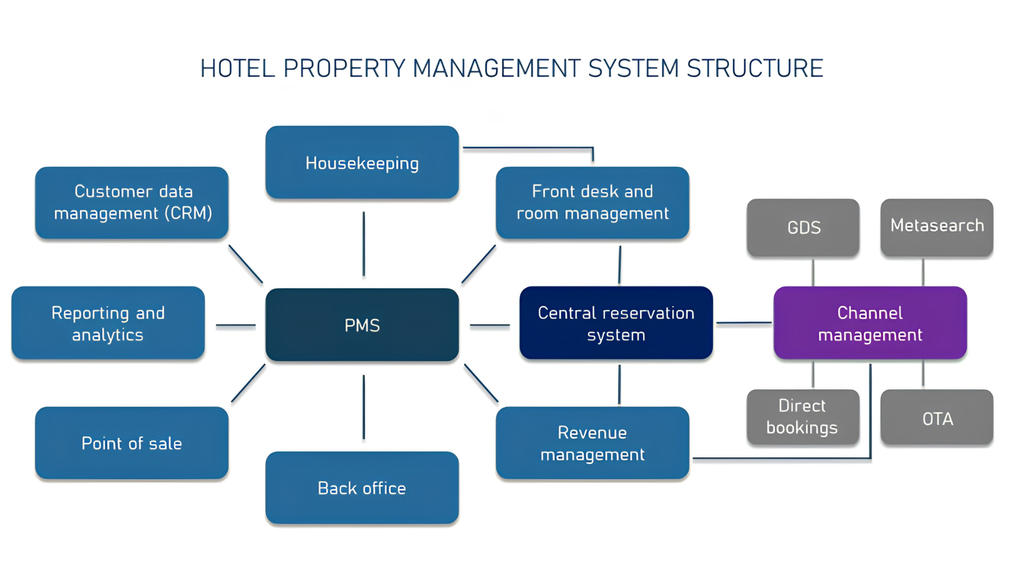
Key functions include:
- Reservation management
- Guest profiles and stay history
- Check-in and check-out
- Billing and payment processing
- Housekeeping coordination
- Reports and performance data
How does a PMS work?
The front desk module manages folios, housekeeping schedules, and room status. The PMS opens a folio to track all expenses, including hotel rate, food and beverage, and other services, when a visitor checks in. The folio is settled at checkout, and payment is processed through an integrated payment gateway. the majority of contemporary PMS systems are cloud-based, employees can access real-time operational data from any device.
At a mid-sized hotel, housekeeping staff using the PMS app reduced room turnaround time by 20%, freeing up rooms sooner for new guests.
What Is a Channel Manager?
A channel manager is a system that enables your hotel to simultaneously list room inventory on all connected booking channels at the same time, reducing the possibility of double bookings.
The channel manager will instantly update availability on all websites when a reservation is made, even on a direct booking website. When closing a room to sale or making large adjustments to hotel inventory, this real-time automation also takes place.
How does a channel manager work in a hotel?
A channel manager shares reservation data in both directions between booking channels and your property management system, automating and updating your hotel's inventory in real-time.
This implies that when a room is reserved on Booking.com, for instance, the channel manager will update your inventory across all of your connected channels, including Expedia and Agoda, and send this information to your PMS.
This procedure will significantly lower your chance of multiple bookings and eliminate human mistake by ensuring that your hotel's inventory is always accurate and current. Additionally, via a single central dashboard, you will be able to manage any updates and monitor performance.
By integrating a channel manager with dynamic pricing, hotels can achieve 10–20% revenue growth through better rate management and visibility.
What Is a Booking Engine?
Your hotel's website serves as the public face when it comes to direct bookings, but the hotel booking engine is the main force behind the scenes. It plays a crucial role in promoting direct reservations since it oversees everything from visitor preferences to room availability.
Hotels that pay 15–25% OTA commissions on each reservation are wasting up to $360,000 annually in revenue that might be obtained for a 2-3% payment gateway cost by a well-designed direct booking engine.
How the Booking Engine Works?
In order to improve the visitor’s experience and hotel operations, the booking engine interfaces and communicates with other systems. Here's how:
- Website: To make sure that what is shown on your website corresponds with actual room availability, the booking engine retrieves real-time availability data from your Property Management System (PMS).
- CMS (Content Management System): The engine collaborates with your CMS to maintain current content, such as room descriptions, photos, and prices.
- PMS (Property Management System): To keep track of reservations and handle room allocations, the booking engine communicates with your PMS.
- Payment Gateway: To manage transactions safely, the engine integrates with payment systems.
- In order to guarantee that your availability and pricing are uniform among OTAs, it also connects with the channel manager.
How These Systems Integrate & Work Together
None of these tools can provide its full value by being disconnected with the other ones. The real advantage comes from integration of these 3 systems.
Here is how a connected workflow usually looks:
- The hotel updates rates and inventory in the PMS.
- The Channel Manager shares that data to Booking.com, Expedia, Agoda, and other connected platforms.
- A guest makes a booking through an OTA or directly through the hotel website.
- That reservation syncs back to the PMS automatically.
- Front desk staff can see the booking in real time, with no manual input required.
This integration reduces manual work, prevents errors, maintains inventory accurately across channels, and allows your team to focus on guests instead of admin tasks.
How to Integrate?
Here are the major steps to integrate your PMS with hotel channel managers and hotel OTAs, along with booking engines and other key systems.
Step 1 - Choose a PMS with open API support or built-in integration capabilities.
Step 2 – Connect your channel manager with your PMS and update your inventory availability in real time.
Step 3 - Integrate your booking engine to automate direct bookings
Step 4 - Switch on OTA sync from your Channel Manager dashboard.
Step 5 – Test the synced system and go live. It will provide comfortable updates on real time basis.
You will also have to integrate your payment gateways, revenue management systems, POS, and CRM. Other housekeeping management and guest communication modules also have to be integrated and customized accordingly.
Which One Does Your Hotel Need?
Most growing hotels need all three of these tools.
The first is usually the operational backbone, or PMS. A channel manager will help you grow your distribution scope without any extra manual work. A booking engine creates a direct revenue stream, reducing the long-term dependency on OTAs.
The ideal combination will depend on your company size, business objectives and your existing technological infrastructure. On the other hand, hotels that blend these three tend to achieve better revenue results and operate more effectively.