How to Choose a Web App Development Partner: A Practical Guide for US Businesses
Learn how to choose a web app development partner with a practical 9-step checklist, red flags to avoid, and key questions to ask before you sign a contract.

Most web app projects do not fail because of bad code. They fail because of a bad match. The scope was fuzzy, the team went quiet after the contract was signed, or the budget ran out before anything useful shipped.
If you are searching for how to choose a web app development partner, you are probably past the idea stage. You have a product to build, a process to digitize, or an old system that needs replacing. The real question is who you trust with it.
This guide walks through nine practical steps for evaluating a web application development company, from writing your brief to signing the contract. You will also find the red flags to watch for, the questions that expose weak teams, and a simple scorecard for comparing vendors side by side. The same logic applies if you are working out how to choose a web development company for a website rebuild or a customer portal.
Why Your Choice of Partner Matters More Than Your Tech Stack

Founders often spend weeks debating React versus Vue, or Node versus Python. In practice, the stack rarely decides whether a project succeeds. The people building it do.
A web app is not a one-time purchase like a laptop. It is a living product. It needs updates, security patches, new features, and someone who understands why a decision was made two years ago. The right software development partner becomes an extension of your team. The wrong one leaves you with code nobody can maintain and a budget that has already been spent.
That is why this decision deserves the same care you would give to a key senior hire.
Step 1: Get Clear on What You Need Before Talking to Anyone
Before you contact a single vendor, write a one-page brief. It does not need to be perfect, but it should answer a few basic questions:
• What problem does the app solve, and for whom?
• Who will use it: customers, staff, partners, or all three?
• Which systems must it connect to, such as a payment gateway, a CRM, or an ERP?
• What does success look like six to twelve months after launch?
• What is your realistic budget range and target launch window?
A clear brief does two things. It lets you compare quotes fairly, and it shows you how each company responds. Strong teams ask sharp follow-up questions. Weak ones send a price within an hour without asking anything.
If you are unsure about scope, a short consulting engagement can save months of rework. Our guide on when business software consulting makes sense explains how to get it right.
Step 2: Decide Which Type of Partner Fits Your Project
Not every project needs a full agency. The table below shows how the common models compare.
| Model | Best for | Watch out for |
| Freelancer | Small, well-defined tasks or early prototypes | Single point of failure and limited capacity |
| Boutique agency | MVPs and custom products that need design plus engineering | Make sure the team you meet is the team that builds |
| Large agency | Enterprise programs with heavy compliance needs | Higher cost and a slower pace |
| Staff augmentation | Adding engineers to an existing in-house team | You still manage the work. See our IT staff augmentation service |
| In-house team | Long-term core products | Hiring time and ongoing payroll |
For many small and mid-sized US businesses, a focused agency or a dedicated team strikes the best balance between cost and accountability. Whichever route you pick, the rest of this guide applies.
Step 3: Evaluate Technical Expertise and Relevant Experience
Look for depth, not a long wall of client logos.
Ask for work that resembles yours
A team that has built a SaaS dashboard may not be the right fit for a healthcare portal or a multi-vendor marketplace. Ask for projects with similar complexity, user volume, or integrations. Detailed case studies tell you far more than polished screenshots. For a sense of what a documented project looks like, read our case study on a biometric attendance sync tool.
Listen to how they think about architecture
Ask how they would structure your app for growth. You are listening for specific answers on API design, database choices, caching, automated testing, and how the app would cope with ten times today's traffic. You do not need to understand every term. You only need to notice whether the answers are concrete or vague.
Confirm they cover the full lifecycle
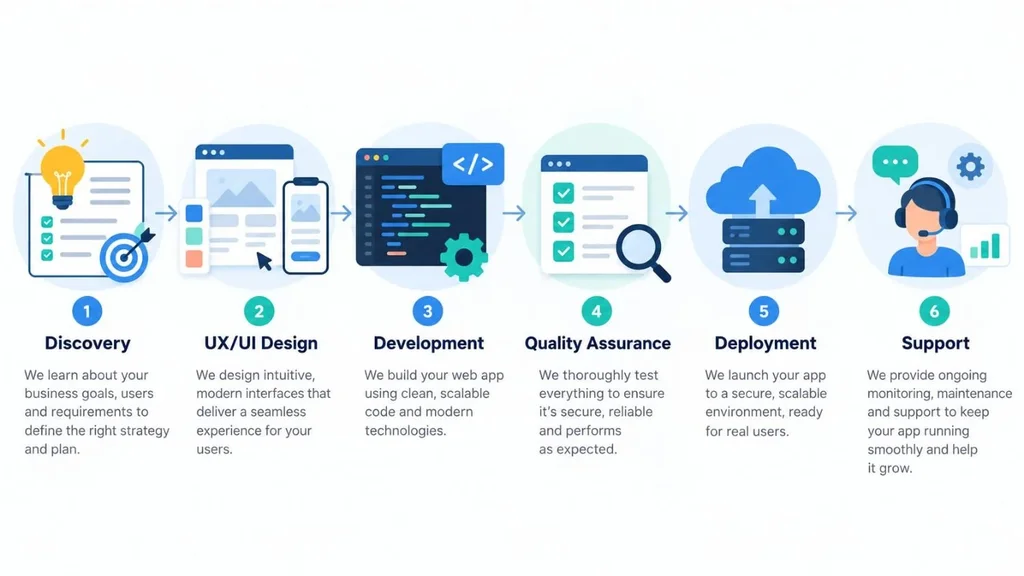
Good custom web app development services include discovery, UX and UI design, development, quality assurance, deployment, and support. If a company covers only one slice, find out who handles the rest. You can see how a full-lifecycle offering is laid out on our web app development services page.
Step 4: Judge Their Process and Communication
Skills get the project built. Communication keeps it on track. Pay close attention during the sales stage, because that is usually the best behavior you will ever see from a vendor.
• Discovery: Do they run workshops or ask for detailed requirements before quoting?
• Method: Agile sprints with a working demo every one to two weeks are a healthy sign.
• Visibility: Will you get access to the backlog, the staging site, and the code repository?
• Time zones: For US clients, at least four hours of overlap with your working day keeps questions from sitting overnight.
• Point of contact: Who do you call when something breaks on a Friday afternoon?
Ask to speak with the project manager and a developer, not only the salesperson. Their answers will show how the team really works day to day.
Step 5: Check Security, Compliance, and Ownership
This is the step many buyers rush, and it is where the costliest mistakes hide.
Security practices
Ask how the team handles secure coding. A solid software development partner should know the OWASP Top 10 web security risks, run code reviews, scan third-party dependencies, and manage secrets properly. The NIST Secure Software Development Framework gives you a useful vocabulary for these conversations. If you want to see how risk is handled in practice, our risk management page is a good reference point.
Compliance for your industry
Depending on your market, you may need to think about HIPAA for health data, PCI DSS for card payments, state privacy laws such as the CCPA in California, and accessibility standards such as WCAG. Accessibility complaints under the ADA are not rare for US websites, so it is worth raising early. A good partner will tell you which rules apply before you ask. Compliance is not a certificate you can bolt on at the end.
Who owns the code
Your contract should state plainly that you own the intellectual property once you have paid. It should also give you access to the source repository, cloud accounts, and documentation throughout the project, not only at the end. If a vendor wants to keep the code or host it on accounts only they control, treat that as a serious warning. This is general information, not legal advice, so have an attorney review the final contract.
Step 6: Understand Pricing Before You Compare It
Price is not the same as cost. A low quote can turn expensive through change requests, rework, and delays. Our breakdown of why software pricing varies explains what sits behind the numbers.
Common pricing models
• Fixed price: Works for tightly defined scope. Changes usually cost extra.
• Time and materials: Flexible, and you pay for actual effort. It needs good oversight and a budget cap.
• Dedicated team: A monthly fee for a team that works only on your product. Good for long-running development.
Hidden costs to ask about
• Hosting and cloud infrastructure
• Third-party licenses and API fees
• Quality assurance and automated testing
• Project management time
• Data migration from older systems
• Post-launch support and maintenance
If two quotes differ by a wide margin, do not simply pick the cheaper one. Ask both teams to walk you through their assumptions. The gap usually comes from scope, seniority, or testing effort.
Step 7: Verify References and Reputation

Reviews on independent platforms such as Clutch and Google Business Profile are a useful start, but they are only a start. Go a few steps further:
1. Call two or three past clients. Ask what went wrong and how the team handled it. Every project has a rough patch.
2. Ask about a project that missed its deadline. An honest answer is a good sign. A claim that nothing ever slips is not.
3. Check how long clients stay. Repeat work and long relationships suggest real trust.
Also look at the company itself. Is there a real team page, a verifiable address, and a consistent track record? A web application development company that hides its people is asking you to take a lot on faith.
Step 8: Start With a Paid Discovery Phase or Pilot
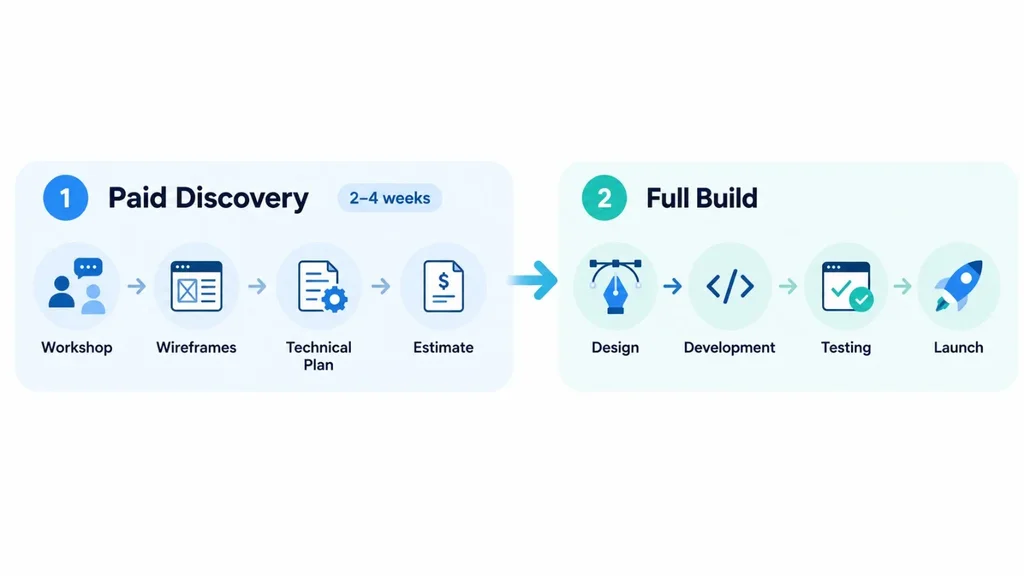
Before signing a full contract, consider a small paid engagement. This could be a two to four week discovery phase that produces wireframes, a technical plan, and a firmer estimate. It could also be a single pilot feature.
It costs a little upfront, but it lets you see how the team works while the stakes are low. If the chemistry is wrong, you walk away with useful documents and a modest loss, not a half-built product.
Step 9: Plan for Life After Launch
Launch day is the starting line, not the finish. Ask early about monitoring, hosting, bug-fix windows, response times, and who handles updates. A partner with strong deployment habits will talk about CI/CD pipelines and automated backups without being prompted. If those terms are new to you, our explainer on what DevOps is is a good primer, and our DevOps services page shows how that support can work in practice.
Think about where the product is going, too. If you expect to add AI features such as smart search or automated support, or a companion app later, ask whether the team has done that work before. Our pages on AI integration and mobile app development show how those pieces can connect to a web app. If your app will sit alongside business systems, our guide to choosing a cloud ERP solution covers the integration questions worth asking.
Onshore, Nearshore, or Offshore: What US Businesses Should Know
Many buyers searching for a web development company USA assume they must hire locally. Location affects cost, time zone, and legal convenience, but it does not guarantee quality.
| Option | Advantages | Trade-offs |
| Onshore (US-based) | Same time zone, familiar contract law, easy in-person meetings | Typically the highest rates |
| Nearshore (for example Latin America or Canada) | Strong time-zone overlap and often lower rates | Experience and process maturity vary by team |
| Offshore (for example South Asia or Eastern Europe) | Wider talent pool and strong cost efficiency | Needs planned overlap hours and clear documentation |
Whichever you choose, the same rules apply: clear scope, regular demos, code ownership, and a contract that names the governing law and jurisdiction. A well-run distributed team with a disciplined process can easily outperform a poorly managed local one.
Red Flags to Watch For
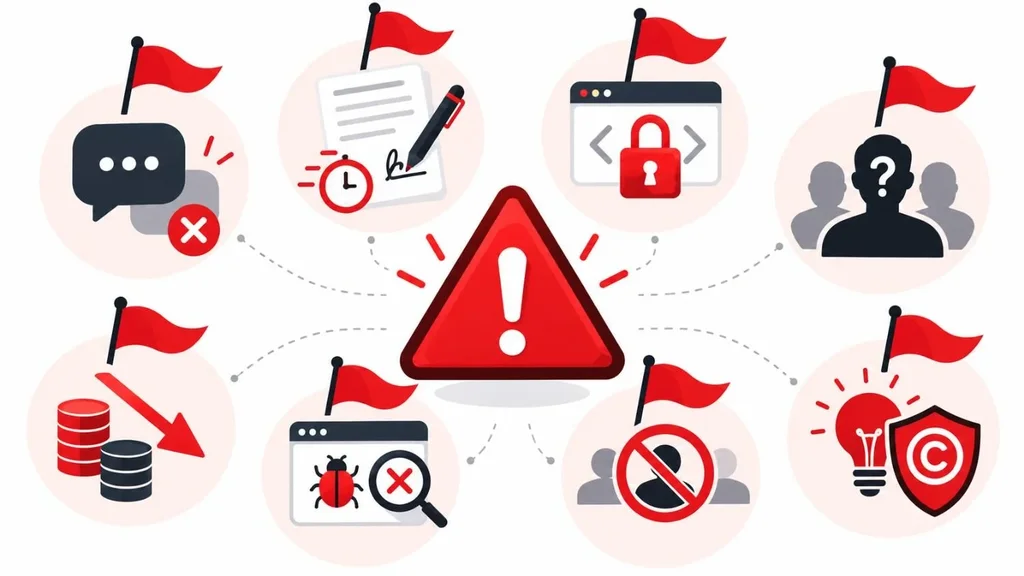
Some warning signs show up early. If you spot several of these, slow down.
• A quote arrives with no discovery call and no questions about your goals.
• Pressure to sign quickly because of a "limited-time" discount.
• No access to the code, the staging site, or the project tools.
• Vague answers about who will actually work on your project.
• A price or timeline that is far lower than every other quote.
• No clear testing or QA process.
• Reluctance to share references.
• Contract terms that leave intellectual property with the vendor.
10 Questions to Ask Before You Sign
1.Can you show me two projects similar to mine, and may I speak with those clients?
2. Who exactly will work on my project, and will they stay on it?
3. How do you handle changes in scope?
4. What does your testing process look like?
5. How do you protect user data and handle security reviews?
6. Who owns the code and the cloud accounts?
7. How often will I see working software?
8. What happens if a key team member leaves mid-project?
9. What does support look like after launch, and what does it cost?
10.Tell me about a project that went wrong. What did you change afterward?
That last question is the most revealing. Teams with real experience have real stories, and they tell them without getting defensive.
A Simple Scorecard to Compare Vendors
To keep the decision objective, score each shortlisted company from 1 to 5 on the criteria below, multiply each score by its weight, and add up the results. Adjust the weights to fit your own priorities.
| Criteria | Weight | Vendor A | Vendor B | Vendor C |
| Relevant experience | 25% | |||
| Technical depth | 20% | |||
| Communication and process | 15% | |||
| Security and compliance | 15% | |||
| Pricing clarity | 10% | |||
| References and reputation | 10% | |||
| Post-launch support | 5% |
Treat this as a thinking tool, not a formula. If a vendor scores well on paper but your gut says something is off, find out why before you move forward.
Conclusion: Choose the Partner, Not Just the Proposal
Learning how to choose a web app development partner comes down to a few habits. Know what you need before you shop. Judge teams on evidence, not promises. Look closely at communication, security, and ownership. And test the relationship with a small paid step before you commit the full budget.
The best partner is rarely the cheapest or the loudest. It is the team that asks good questions, tells you the truth when it is inconvenient, and leaves you with a product you fully control.
If you are ready to talk through your project, you can explore our custom web app development services or get in touch with our team to discuss scope, timeline, and next steps.
Frequently Asked Questions
How do I choose a web app development partner for my business?
Start with a clear one-page brief, then shortlist three to five companies with relevant experience. Compare them on technical depth, communication, security practices, pricing transparency, and client references. Before committing, run a short paid discovery phase to see how the team works in real conditions.
How much does custom web app development cost in the USA?
There is no single number, because cost depends on scope, complexity, integrations, and team location. Small internal tools can start in the tens of thousands of dollars, while complex platforms can run well into six figures or beyond. Ask for itemized estimates and find out what is excluded. Our article on why software pricing varies explains the main cost drivers.
Should I hire a freelancer or a web application development company?
A freelancer suits small, clearly defined tasks. A company is usually the safer choice for a full product, because you get a team with design, development, testing, and project management, plus continuity if one person leaves. For ongoing capacity, staff augmentation is another option.
How long does it take to build a custom web app?
A focused MVP often takes around three to six months, while larger platforms with many roles, integrations, or compliance needs take longer. A discovery phase gives you a more reliable timeline than any early estimate.
What should a contract with a software development partner include?
At minimum, it should cover intellectual property ownership, scope and milestones, the payment schedule, a process for handling changes, confidentiality, security obligations, a bug-fix warranty period, support terms, and a clear exit and handover plan. Have an attorney review it, since this is general information and not legal advice.