Custom Ecommerce Solutions: When to Build, What It Costs, and How to Do It Right
Learn when custom ecommerce solutions beat off-the-shelf platforms, what US businesses typically spend, and how to plan a build that pays off.
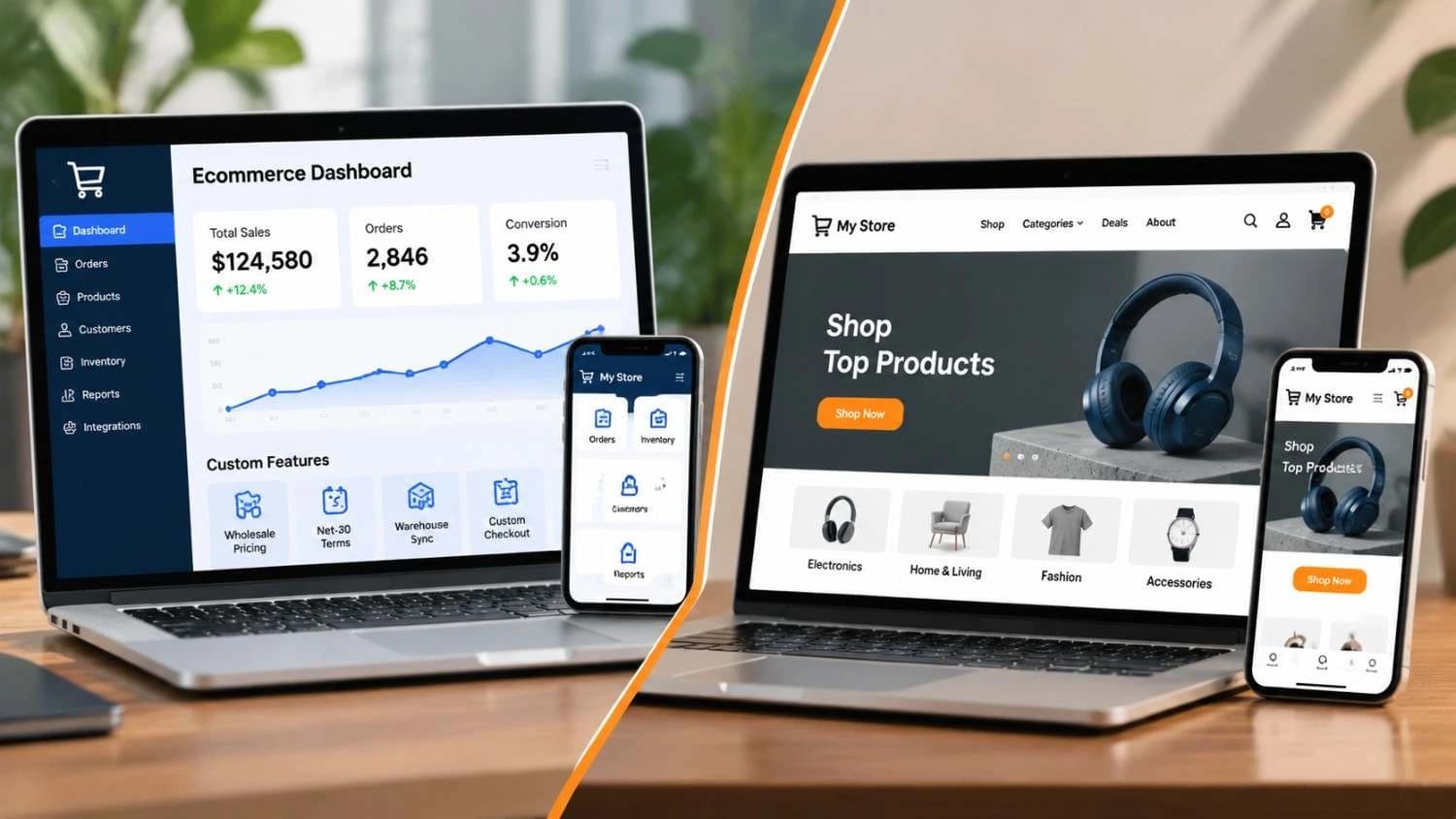
Every growing online store hits a wall at some point. Checkout rules get too complicated for a plugin. Stock counts in the store disagree with the warehouse. A wholesale customer asks for net-30 terms, and the platform has no way to offer them.
That is usually the moment owners start searching for custom ecommerce solutions. The real question is not whether custom software sounds impressive. It is whether it will earn back its cost in your business.
The market gives you little room to stand still. The U.S. Census Bureau reports that e-commerce reached 17.1% of total US retail sales in the second quarter of 2026, about $340.2 billion, and grew 12.2% year over year while total retail grew 6.7%.
This guide walks through the decision the way a careful technical consultant would. You will see what "custom" really means, how it compares with Shopify or WooCommerce, what it costs, how a build runs from first workshop to launch, and what to check before you hire an ecommerce development company.
What Are Custom Ecommerce Solutions?
A custom ecommerce solution is an online selling system built, or heavily adapted, around how your business actually works. You are not bending your process to fit a template. The software bends to fit you.
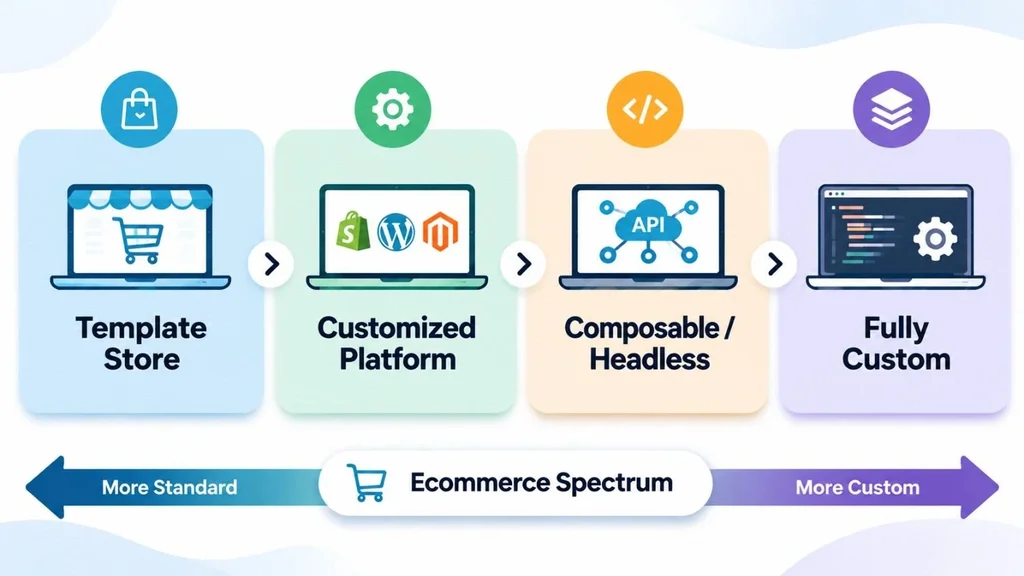
It helps to see this as a spectrum instead of a yes-or-no choice:
• Template store: a theme plus apps. Fast and affordable, with limited business logic.
• Customized platform: Shopify Plus, WooCommerce, or Magento extended with custom code for pricing, checkout, or integrations.
• Composable or headless: a custom front end connected through APIs to services for cart, search, and payments.
• Fully custom: your own codebase and data model, built for workflows no platform supports.
Most successful projects land in the middle two. Going fully custom from scratch is rarely the best first move. If an agency recommends it without asking detailed questions about your workflows, treat that with some skepticism.
Custom vs Off-the-Shelf Platforms: A Fair Comparison
Neither side wins every time. Here is how they compare on the factors that matter most:
| Factor | Off-the-shelf platform | Custom solution |
| Time to launch | Days to weeks | Months |
| Upfront cost | Low | Higher |
| Recurring cost | Subscription, transaction fees, paid apps | Hosting, maintenance, developer time |
| Flexibility | Limited to platform rules and apps | Built around your workflows |
| Code and data ownership | Platform controls the stack | You own the code and data model |
| Maintenance | Handled by the vendor | Your team or partner handles it |
| Scaling for unusual logic | Often needs workarounds | Designed in from the start |
Shopify's own enterprise team argues that maintenance is the hidden cost of custom builds, and that is a fair point. Custom code means you own every bug, upgrade, and security patch.
The opposite problem is just as real. Stores on hosted platforms often end up with a dozen paid apps patching the same gaps, each with its own fee and its own failure modes. If you are still weighing options, our guide on choosing the right ecommerce platform explains how the main platforms differ.
Signs You Have Outgrown Your Current Platform
Look for patterns like these:
• You pay for several apps that overlap, and they sometimes conflict.
• Staff re-key orders from the store into accounting or ERP software by hand.
• Prices depend on customer, contract, quantity, or region, and the platform cannot model that.
• Pages slow down or checkout fails during sales and holiday peaks.
• You need quotes, approvals, or split shipments, and the platform treats them as edge cases.
• Platform limits, not strategy, decide your roadmap.
If two or three of these sound familiar, a paid discovery phase is worth the money. If only one does, a targeted extension of your current platform may solve it for a fraction of the price of a rebuild.
Features Worth Building Custom
Not every feature deserves custom code. Spend the budget where your business is genuinely different and buy everything else. These are the areas where custom ecommerce development services usually pay off.
Pricing and checkout logic
Tiered pricing, contract rates, bundles, subscriptions, and region-specific tax or shipping rules are hard to model with plugins. A custom pricing engine keeps the rules in one place, so the price a customer sees is the price your finance team expects.
Inventory and order management
Real-time stock across warehouses, stores, and marketplaces prevents overselling. Custom order management also lets you route orders by location, split shipments, and handle backorders the way your operations team actually works.
Integrations with ERP, CRM, and shipping
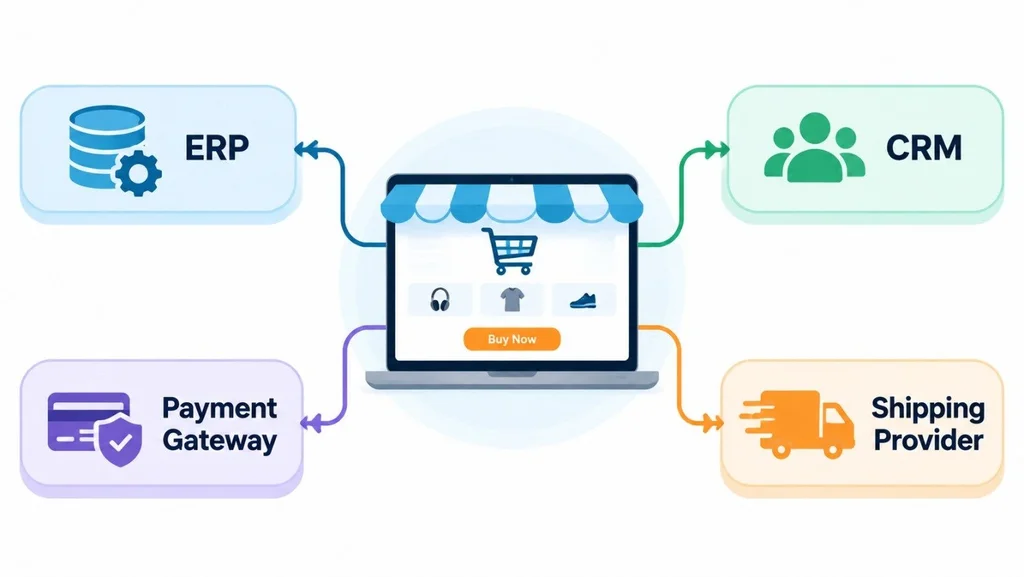
This is where custom work often shows its value most clearly. When products, stock, prices, and invoices flow between the store and your back office automatically, you remove manual entry and the errors that come with it. Our ERP solutions work is built around exactly this kind of connection.
Search, merchandising, and personalization
Large catalogs need search that understands your product attributes, not generic keyword matching. If you want smarter recommendations or support chat, AI integration can be added on top of clean product and order data.
Admin tools for your own team
Customer service and operations staff spend hours a day inside the back end. A custom admin panel that shows the right order, customer history, and actions on one screen saves real time every week, and it is rarely visible to shoppers.
Custom B2B Ecommerce Development Solutions
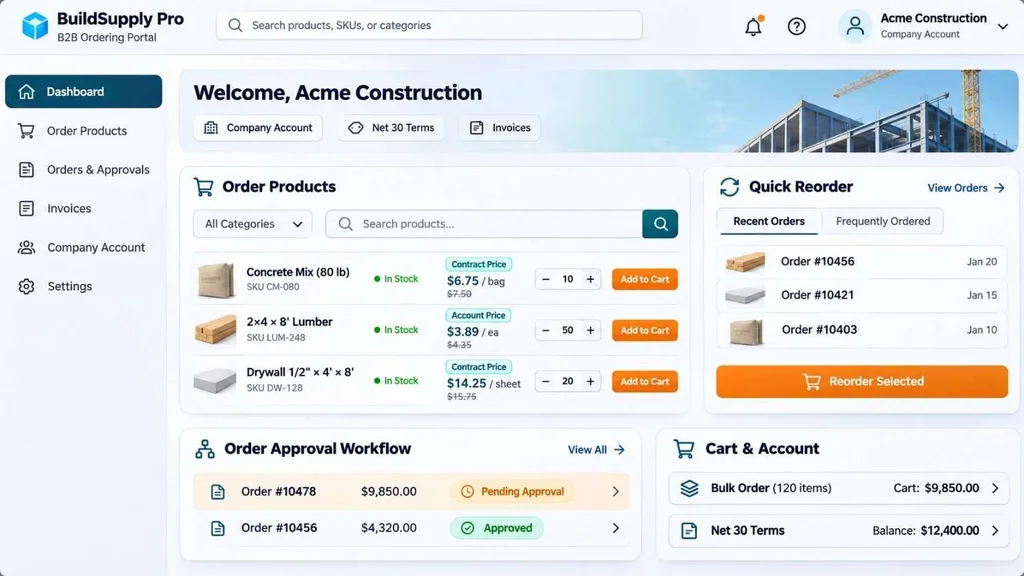
B2B buyers expect the same ease as consumer shopping, with added business rules. Gartner research cited by Workday found that 61% of B2B buyers prefer an overall rep-free buying experience, so a weak portal costs you orders.
Standard consumer carts rarely handle these needs well:
• Customer-specific price lists and negotiated contract rates.
• Company accounts with multiple buyers, roles, and spending limits.
• Quote requests and approval workflows before an order is placed.
• Net terms, credit limits, and invoice-based payment.
• Minimum order quantities, bulk uploads by CSV, and one-click reorders.
• Order history and live stock visibility tied to your ERP.
Consider a building-supply distributor with 400 contractor accounts. Each account has its own discounts, and every large order needs a project manager's approval. A portal that applies those rules automatically removes dozens of phone calls and emails a day. That is the kind of result a well-scoped B2B ecommerce development solution should aim for. Canduit's ecommerce development service covers wholesale portals, tiered pricing, and approval flows for this reason.
Security and Compliance You Cannot Skip
A custom build puts security in your hands, so plan for it from day one.
• Card data: send payments through a PCI-validated processor such as Stripe or Adyen instead of handling raw card numbers yourself.
• Payment page scripts: PCI DSS v4.0.1 requirements 6.4.3 and 11.6.1, mandatory since March 31, 2025, cover how scripts on payment pages are authorized and monitored. Check whether they apply to your setup.
• Privacy: state laws such as the California Consumer Privacy Act affect how you collect and store customer data.
• Accessibility: build to WCAG 2.2 AA so more shoppers can buy, and to reduce legal risk.
Uptime matters too. A store that crashes on Black Friday loses money in minutes, so load testing and a sound DevOps setup belong in the plan, not in the post-launch wish list.
The Custom Ecommerce Development Process
Good ecommerce website design and development follows a clear sequence. The timings below are typical for a mid-sized project, and most builds land between three and nine months overall.
1. Discovery (2 to 4 weeks): map your catalog, customers, workflows, and systems. This step produces a written scope and a realistic budget.
2. UX and design (3 to 6 weeks): wireframes and clickable prototypes for the storefront, checkout, and account areas, tested with real users before any code is written.
3. Development (8 to 20 weeks): built in sprints with reviewable builds every one or two weeks, so you can correct course early.
4. Integration and testing (3 to 6 weeks, often overlapping): payments, tax, shipping, and ERP connections tested with realistic order scenarios, plus performance and security checks.
5. Data migration and SEO preparation: clean product data, redirect map, and metadata carried over from the old site.
6. Launch: a staged rollout is safer than a single big cutover for high-volume stores.
7. Post-launch support: monitoring, fixes, and a roadmap for the next features.
Mistakes that cost the most
• Building something you could have bought. Custom code should cover your differences only.
• No single product owner on your side to make decisions and approve work.
• Messy product data. Cleaning it late delays launch more than any technical issue.
• Skipping load testing before a sale or seasonal peak.
• No budget for the months after launch.
How Much Do Custom Ecommerce Solutions Cost in the US?
Anyone who quotes a single price without understanding your scope is guessing. Published agency ranges vary widely, so use the figures below as planning ranges, not quotes. Rates also differ by team location and seniority.
| Project type | Typical budget (USD) | Typical timeline |
| Customized hosted platform with a custom app or integration | $15,000 to $60,000 | 6 to 12 weeks |
| Custom B2C store with several integrations | $60,000 to $200,000 | 4 to 7 months |
| Custom B2B portal or marketplace with ERP integration | $120,000 to $400,000+ | 6 to 12 months |
Five things move the number the most:
• The number and complexity of integrations.
• Custom pricing, tax, or approval logic.
• Catalog size and the state of your product data.
• Design depth, including custom animations and mobile apps.
• Compliance, performance, and security requirements.
Do not forget running costs. A common planning rule is to reserve roughly 15% to 20% of the build cost each year for hosting, security patches, monitoring, and small improvements. That is still often lower than years of platform fees plus workaround apps, but only if you plan for it.
Build SEO and Performance In From the Start
A rebuild is the most common moment for stores to lose organic traffic. Google's guidance on search says that standard SEO practices still apply to AI features, and that includes crawlable pages, good page experience, and original content. Your developers should handle these from the first sprint:
• A URL map with 301 redirects from every old page that ranks or earns links.
• Server-side or pre-rendered pages if you go headless, so search engines can read your products.
• Product structured data and a clean Google Merchant Center feed.
• Fast load times on mobile, tracked through Core Web Vitals.
• Original product descriptions instead of copied supplier text.
Our overview of ecommerce tools lists analytics and SEO tools worth connecting before launch.
How to Choose an Ecommerce Development Company
The partner you pick shapes the outcome more than the technology does. Whether you are comparing an ecommerce website development company in the US or an offshore team, ask these questions:
• Will we receive a written scope, timeline, and architecture overview before we commit?
• Do we own the source code, hosting accounts, and data from day one?
• Can you show projects with similar integrations and a similar scale?
• Who supports the store after launch, and what are the response times?
• How do you test for security and performance?
• Will we deal with the people who build the product, or only with sales?
Be careful with fixed-price quotes that skip discovery, and with vague answers about integrations. For a deeper checklist, read our guide to choosing a custom software development company.
Conclusion
Custom ecommerce solutions make sense when your pricing, workflows, or integrations are what set your business apart, and when a platform keeps forcing you into workarounds. They make less sense when a well-configured hosted store would do the job.
Start with discovery, not code. Define the processes that truly need to be custom, budget for life after launch, protect your SEO during the move, and choose a partner who is open about trade-offs. Done that way, custom ecommerce website development becomes an investment that grows with the business instead of a project that outlives its usefulness. If you want to talk through your own case, you can explore Canduit's custom ecommerce development services or ask for a scoped discovery.
Frequently Asked Questions
What are custom ecommerce solutions?
Custom ecommerce solutions are online stores or selling systems built or heavily extended to match a company's specific products, pricing, workflows, and software. They range from a hosted platform with custom apps to a fully coded storefront with its own data model.
How much do custom ecommerce solutions cost in the US?
Most projects fall between about $15,000 for a customized hosted store and $400,000 or more for a complex B2B portal or marketplace. Scope, integrations, and design depth drive the price. Plan on roughly 15% to 20% of the build cost per year for upkeep.
How long does custom ecommerce website development take?
A typical project takes three to nine months. Simple builds can launch in two to three months, while multi-system B2B platforms can take a year. A proper discovery phase gives you a reliable timeline before development begins.
Is custom ecommerce better than Shopify or WooCommerce?
Not always. Shopify and WooCommerce are excellent for standard stores and launch faster. Custom makes more sense when you need complex pricing, B2B workflows, deep ERP integration, or full control over code and data.
Can a custom ecommerce store connect to my ERP, CRM, and shipping tools?
Yes. Integration is one of the strongest reasons to go custom. A well-built store syncs products, stock, orders, and invoices with your ERP, CRM, payment, tax, and shipping providers, which removes manual entry and reduces errors.