How to Choose a Custom Software Development Company (Without Costly Mistakes)
Learn how to choose a custom software development company with a clear vetting process, smart questions, and red flags to avoid.

Choosing a software partner feels a lot like hiring a surgeon. You are handing over a key part of your business, and you will likely live with the result for years. Even so, many buyers pick a vendor based on a polished website and the lowest quote.
That is usually where trouble starts. Budgets stretch, deadlines slip, and the finished product does not match what the team really needed.
This guide shows you how to choose a custom software development company using a process you can start this week. You will learn what to check, which questions expose weak vendors, how pricing and outsourcing models differ, and which red flags should end a conversation early.
The short answer: pick the company that diagnoses your problem before it quotes, shows relevant work you can verify, names the people who will build your product, gives you full ownership of the code, and explains its pricing in plain terms. Everything else is secondary.
What a Custom Software Development Company Actually Does
A custom software development company designs, builds, tests, launches, and maintains software made for one specific business, instead of selling a ready-made product to everyone. Typical custom software development services include web and mobile apps, internal tools, ERP and CRM systems, integrations, cloud and DevOps work, and a growing number of AI features.
You will also see the terms software development company, software development agency, studio, and consultancy used for similar providers. The label matters less than the model behind it. Some teams build in-house, some mostly resell staffing, and some subcontract the actual coding. That difference becomes important later in this guide.
If you are still deciding whether to build at all, this explainer on what custom software is and when it makes sense covers the trade-offs against off-the-shelf tools.
Start With Your Own Requirements, Not Their Pitch
The best vendor conversations start with a prepared buyer. Before you contact anyone, write a one-page brief that covers:
• The problem you want to solve, in plain language rather than a feature list
• Who will use the software and roughly how many users you expect
• Systems it must connect to, such as accounting, payments, or an existing ERP
• A realistic budget range and a target launch window
• Compliance needs, such as HIPAA, PCI DSS, or SOC 2 expectations from your own customers
• What success looks like six to twelve months after launch
A brief like this does two things. It lets you compare quotes on equal footing, and it quickly shows which vendors ask smart follow-up questions. If your scope is still fuzzy, an independent consultation costs far less than guessing. This piece on business software consulting explains when that extra step pays off.
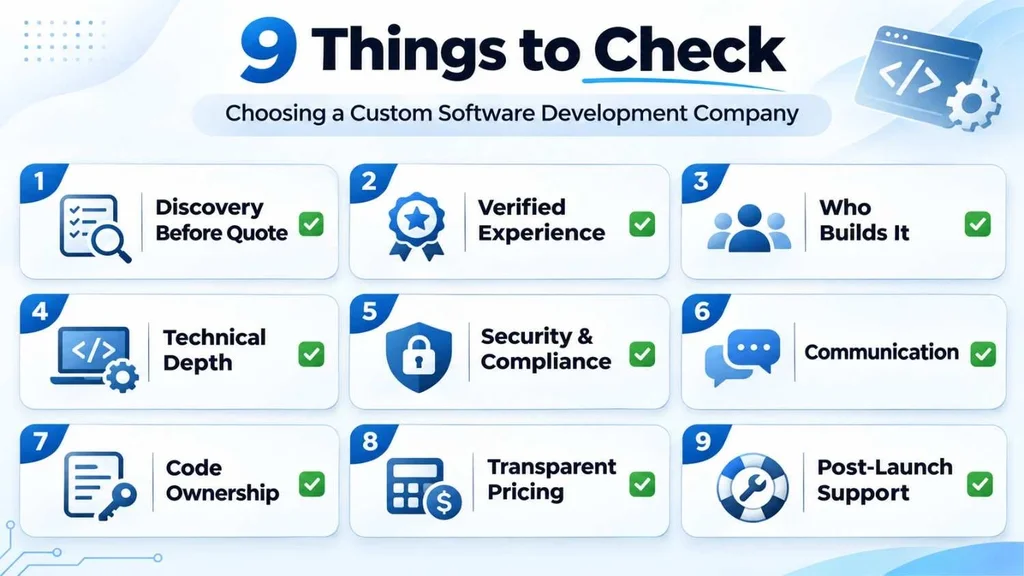
9 Things to Check When You Choose a Custom Software Development Company
1. A Discovery Process That Comes Before the Quote
Strong teams ask questions before they price anything. They want to understand your users, your workflows, and what happens if the project fails. A vendor who sends a fixed quote after one 30-minute call is guessing, and you will pay for that guess later through change requests.
Look for a structured discovery phase that produces written deliverables, such as user stories, a rough architecture, a prioritized feature list, and a risk list. It is normal for this phase to be paid, and it is money well spent.
2. Relevant Experience You Can Verify
Logos and screenshots prove very little. Ask for case studies that match your industry, your company size, or your technical complexity. Even better, ask for a live demo of something they built, or a call with a past client.
When you speak to references, ask what went wrong and how the team handled it. Every real project hits a snag, and the response tells you more than a flawless five-star story. Review platforms such as Clutch publish verified client feedback, which helps as a cross-check, but reviews should never be your only source. You can see how an industry-specific build is documented in this dairy manufacturing ERP case study.
Hiring specifically for a browser-based product? The checklist on choosing a web app development partner goes deeper on that stack.
3. Who Will Actually Build Your Product
Many software development agencies sell with senior people and deliver with juniors. Ask for the names, roles, and years of experience of the people on your project. Ask whether they are employees or subcontractors, and what happens if someone leaves mid-project.
Here is a simple test. Request a short call with the tech lead, not only the sales rep. Their answers to technical questions will show you the real depth of the team within minutes.
4. Technical Depth and Sound Architecture
You do not need to be technical to test this. Ask why they recommend a specific stack for your project and what alternatives they considered. A good partner explains trade-offs in plain English, covering scalability, maintenance cost, and how easy it will be to hire developers for that technology later.
Also ask about testing and code quality. Automated tests, code reviews, and CI/CD pipelines are standard practice for serious teams. If the answer is vague, expect bugs after launch. Building an app for phones? This guide to choosing a mobile app development company covers platform choices such as native versus cross-platform.
5. Security and Compliance Habits
Your software will hold customer data, so security cannot be an afterthought. Ask how the company handles secure coding, access control, and secrets management. The NIST Secure Software Development Framework (SP 800-218) gives a useful reference point for what good practice looks like.
If you operate in a regulated space, confirm direct experience with the rules that apply to you, for example HIPAA for health data, PCI DSS for card payments, or SOC 2 for SaaS vendors. Ask for proof instead of promises, such as certifications, audit summaries, or past compliance work.
6. Communication and Project Management
Most failed projects trace back to poor communication, not poor code. Agree early on how often you will see working software. Two-week sprints with a demo at the end of each are a healthy rhythm.
Check the practical details too. Who is your single point of contact? Which tools will you use for tasks and chat? How many working hours overlap with their team? A vendor several time zones away can work well, but only if that overlap is planned.
7. Code Ownership and Contract Terms
This is where buyers get burned most often. Your contract should state that you own the intellectual property and source code once you pay. Confirm that you get repository access from day one, not at the end. Ask which third-party libraries or licenses are involved and whether any of them would limit how you use the product.
Look for an exit clause, clear acceptance criteria for each milestone, a confidentiality agreement, and a documented handover process. If you ever switch vendors, these terms decide whether the move takes weeks or becomes a hostage situation. Have a lawyer review the agreement, because this article is general guidance and not legal advice.
8. Transparent Pricing and Total Cost
The lowest quote is rarely the cheapest outcome. Compare what each estimate actually includes: discovery, design, testing, project management, deployment, and a warranty period. Ask for the assumptions behind the numbers and what triggers a change request.
Published 2026 cost guides commonly place small to mid-size custom projects between roughly $30,000 and $200,000, with focused MVPs starting lower and enterprise platforms going well above that. Treat these figures as rough context only, since scope, integrations, and compliance needs move the price a lot. For a closer look at why quotes differ so widely, read why software pricing varies.
9. Post-Launch Support and Maintenance
Launch day is the start of the journey, not the finish. Software needs security patches, dependency updates, hosting care, and steady improvements. Ask what support looks like after go-live, including a warranty window for bug fixes, response-time commitments, and monthly maintenance options.
Plan for ongoing costs as well. Many teams budget around 15 to 20 percent of the original build cost per year for maintenance, though your real figure depends on complexity. Ask the vendor for their own numbers instead of relying on a generic rule.
Fixed Price, Time and Materials, or Dedicated Team?
The pricing model shapes how risk is shared between you and the vendor, so it deserves as much attention as the price itself.
| Model | Best for | Main risk |
| Fixed price | Small projects with a locked, well-documented scope | Scope changes get expensive, and teams may cut corners to protect margin |
| Time and materials | Evolving products, MVPs, and projects still learning from users | Budget can drift without a monthly cap and regular reporting |
| Dedicated team | Long roadmaps and products that need steady development | Higher commitment, and it needs strong product ownership on your side |
A practical rule: use fixed price only when the scope is truly settled. If you are still learning what users need, time and materials with an agreed monthly cap gives you flexibility without open-ended spending.
Onshore, Nearshore, or Offshore? Software Development Outsourcing Explained
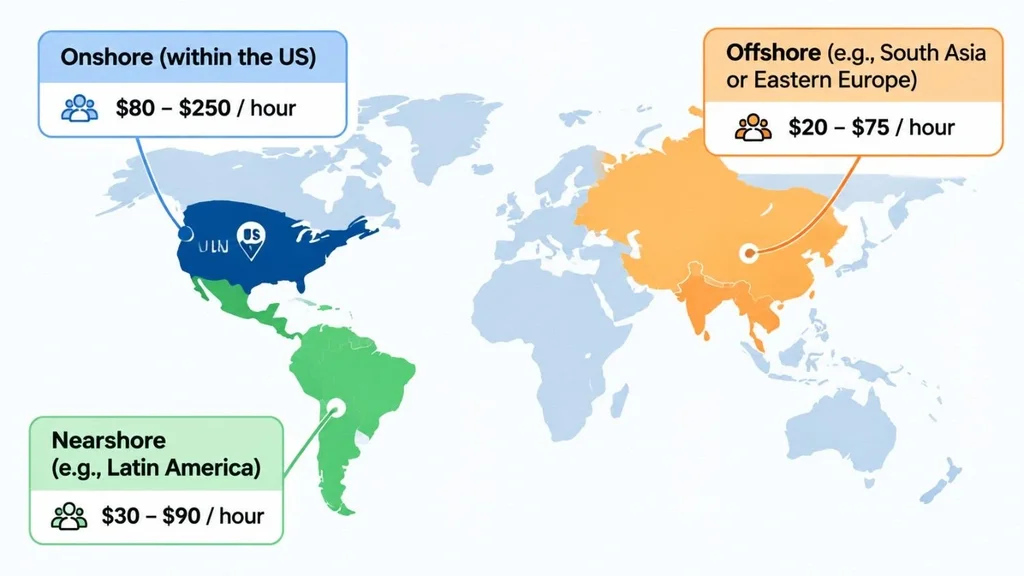
Software development outsourcing simply means hiring an outside team instead of building in-house. Where that team sits changes cost, speed of collaboration, and legal setup.
• Onshore (within the US): easiest legal and cultural fit, same time zone, and the highest rates. Industry estimates run from roughly $80 to $250 per hour depending on seniority and firm size.
• Nearshore (such as Latin America): strong overlap with US business hours. Estimates often fall between $30 and $90 per hour.
• Offshore (such as South Asia or Eastern Europe): the widest price range, commonly from about $20 to $75 per hour, with more planning needed for time-zone gaps.
These figures come from 2026 vendor-published cost guides, so treat them as indicative and expect differences between sources. More importantly, rate is not the whole story. A cheaper hourly rate can still cost more once rework, delays, and management time pile up.
Decide based on how much real-time collaboration your project needs, your security requirements, and how clearly your scope is defined. If you want developers who work like part of your own team over a long roadmap, an IT staff augmentation model is worth a look.
How to Vet Your Shortlist, Step by Step
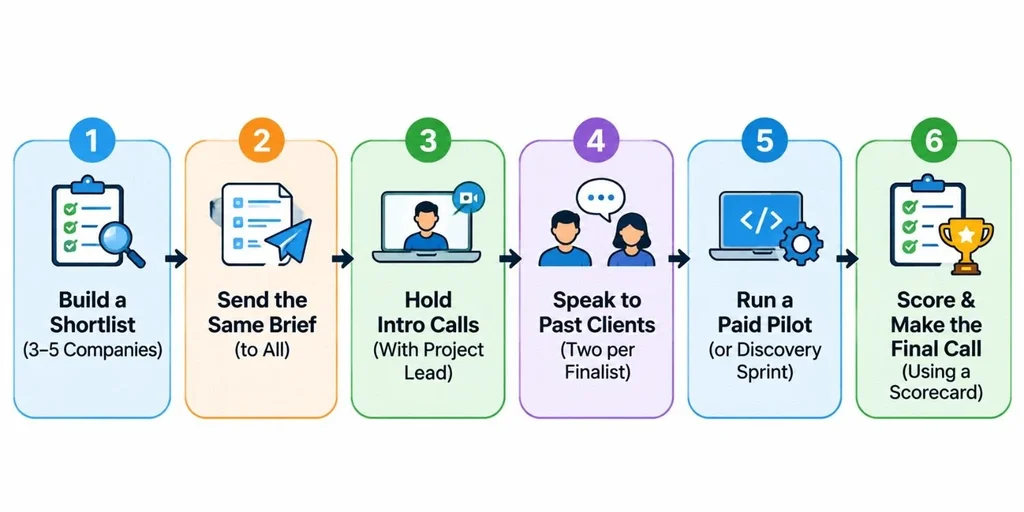
1. Build a shortlist of three to five companies from referrals, review platforms, and search. Check that each has recent work similar to yours.
2. Send the same written brief to all of them. Note who asks thoughtful questions and who only sends a price.
3. Hold intro calls with the project lead, not only the sales contact.
4. Speak to two past clients per finalist, and ask about delays, surprises, and support after launch.
5. Run a small paid pilot or discovery sprint with your top one or two choices. Real work reveals more than any proposal.
6. Score each finalist on the same scorecard and make the final call.
A simple weighted scorecard keeps the decision fair and stops the loudest voice in the room from winning. Adjust the weights to fit your project.
| Criterion | Weight | What a strong score looks like |
| Discovery and process | 20% | Written discovery deliverables before any final quote |
| Relevant experience | 15% | Verifiable case studies and reachable references |
| Team quality | 15% | Named senior people, mostly employees, low turnover |
| Communication | 10% | Regular demos, one point of contact, planned time overlap |
| Security and compliance | 10% | Documented practices and proof for your regulations |
| Contract and IP | 10% | You own the code, repository access from day one, clear exit terms |
| Pricing transparency | 10% | Itemized estimate with stated assumptions |
| Post-launch support | 10% | Warranty period and clear maintenance options |
Questions to Ask Before You Sign
Use these in your calls. The way a company answers is often more telling than the answer itself.
1. What problem do you think we are really trying to solve?
2. Who exactly will work on our project, and can we meet them?
3. Can you share two references from projects similar to ours?
4. How do you handle scope changes and delays?
5. Who owns the code, and when do we get repository access?
6. How do you test software before each release?
7. What does support look like after launch, and what does it cost?
8. What could make this project fail, and how would you reduce that risk?
Red Flags That Should Make You Pause
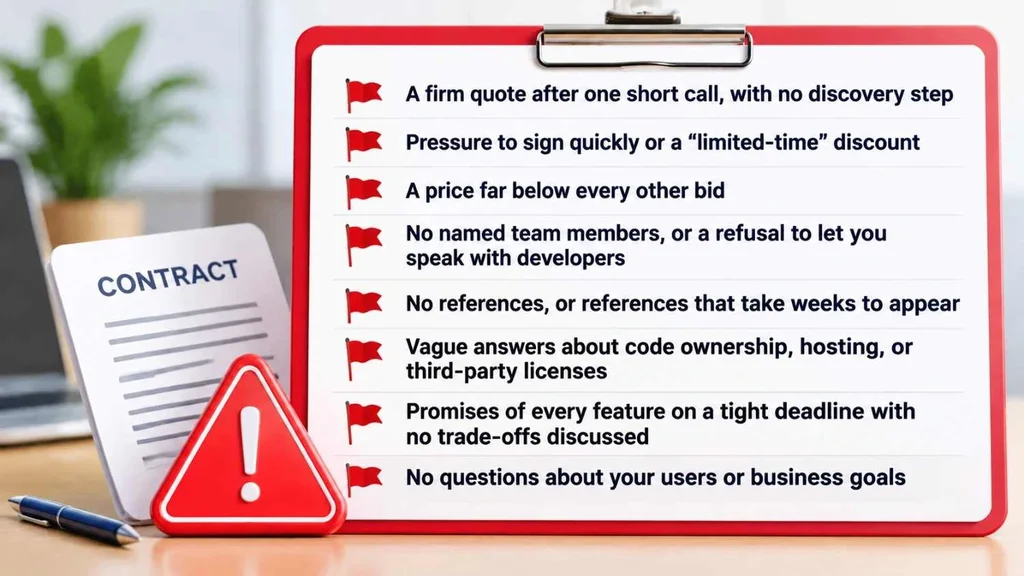
• A firm quote after one short call, with no discovery step
• Pressure to sign quickly or a "limited-time" discount
• A price far below every other bid
• No named team members, or a refusal to let you speak with developers
• No references, or references that take weeks to appear
• Vague answers about code ownership, hosting, or third-party licenses
• Promises of every feature on a tight deadline with no trade-offs discussed
• No questions about your users or business goals
One red flag may be a simple communication slip. Three or more is a pattern, and it is usually better to walk away early than to renegotiate midway through a build.
What This Looks Like in Practice
Here is a typical scenario, based on common patterns rather than one specific client. A regional distributor needs a custom ordering portal and asks two agencies for quotes.
Agency A replies in two days with a fixed price. Agency B asks for a workshop, talks to the warehouse staff, and returns with a phased plan that starts with a smaller first release. Agency B costs more up front, but its discovery uncovers an integration with the accounting system that Agency A never mentioned.
That one missing item would have meant extra weeks and a change order later. The lesson is simple: the vendor who asks the most questions early often saves you the most money.
Conclusion
Knowing how to choose a custom software development company comes down to a handful of habits. Define your problem first. Favor teams that run a real discovery phase. Verify their experience through demos and references. Insist on clear code ownership and plain-language pricing. Then test your top choice with a small paid pilot before committing to the full build.
No vendor is perfect, and you do not need perfection. You need a partner who communicates honestly, protects your interests in the contract, and stays accountable after launch. Use the scorecard and questions above, trust the evidence over the sales pitch, and you will be far ahead of most buyers.
Frequently Asked Questions
How do I choose a custom software development company for a small business?
Start with a one-page brief, shortlist three to five firms with similar past projects, and compare them using the same scorecard. Small businesses benefit most from a paid discovery phase, a phased delivery plan, and a contract that gives you full ownership of the code.
How much does custom software development cost?
It depends on scope, integrations, compliance needs, and team location. Published 2026 guides commonly cite roughly $30,000 to $200,000 for small to mid-size projects, with simple MVPs costing less and enterprise platforms costing much more. Only a discovery phase can give you a reliable estimate.
What is the difference between a software development company and a software development agency?
In everyday use the terms overlap. Agencies often work project by project and may lean toward design and marketing-driven builds, while software development companies may also offer long-term engineering, product support, and dedicated teams. Judge each provider by its process, team, and track record rather than its label.
Is software development outsourcing safe?
It can be, when you manage the risks. Use a written contract with IP ownership and confidentiality terms, confirm the vendor's security practices, keep repository access on your side, and start with a small pilot. Many companies outsource successfully; problems usually come from vague scope and weak contracts.
How long does it take to build custom software?
A focused MVP often takes about three to six months, while larger systems with many integrations can take a year or more. Timelines depend on scope clarity, decision speed on your side, and team size. A phased release plan helps you get value earlier.