How to Choose a Mobile App Development Company Without Wasting Your Budget
Choosing a mobile app development partner is easier with a clear checklist, honest US cost ranges, and the red flags to spot before you sign.

Picking the wrong development partner is one of the most expensive mistakes a business can make with a new app. The code may still ship. But the budget doubles, the launch slips by months, and you end up with a product your own team cannot maintain.
So how do you choose a mobile app development company you can trust? The short answer: define your goals and budget first, shortlist three to five firms with proven work in your category, check their live apps and references, compare itemized estimates, and confirm code ownership and post-launch support in writing before you sign.
This guide walks through each step in detail. You will also find realistic US cost ranges, ten questions to ask on every sales call, a list of red flags, and a simple scorecard for comparing your shortlist. If you are still getting familiar with the basics, start with our overview of what mobile app development involves.
Start With Your Own Homework First
Agencies can only give accurate quotes when you give them clear input. Before you book a single call, write down the following:
• The problem. Who is the app for, and what job does it do for them?
• Version one features. List the must-haves, and park everything else for version two.
• Platforms. iOS, Android, or both. Check where your customers actually are.
• Budget range. Even a rough range helps agencies suggest the right scope instead of guessing.
• Timeline pressure. Is there a fixed date, such as a trade show or a seasonal campaign?
• An internal owner. One person on your side who can decide quickly and answer questions.
A one-page brief with these points can save you weeks. It also works as a test. A good team will challenge parts of it, while a weak team will simply say yes to everything.
Know Which Type of Partner You Need
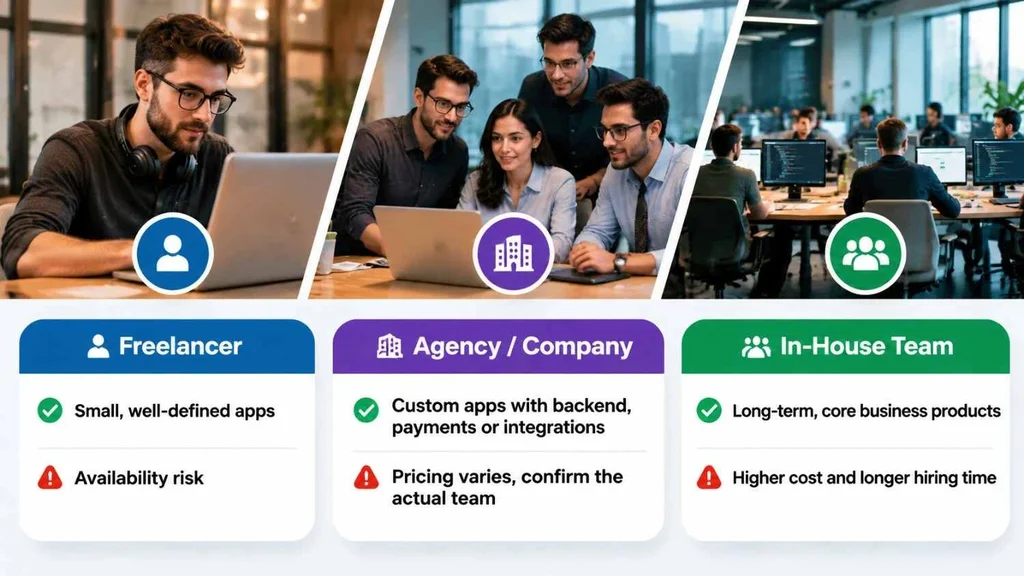
Not every project needs a full agency. The right choice depends on scope, budget, and how much management you can handle yourself.
| Option | Best for | Watch out for |
| Freelancer | Small, well-defined apps or quick prototypes | One person covers design, code, and testing, so availability is a real risk |
| Mobile app development company | Custom apps with a backend, payments, or integrations | Pricing varies widely, so confirm who will actually build your app |
| In-house team | Long-term products at the core of your business | Hiring takes months, and salaries add fixed cost |
| Hybrid (agency plus your team) | Companies with some engineers who need extra capacity | Needs clear ownership of decisions |
If your product needs a custom backend, an admin dashboard, or links to other systems, you are in custom mobile app development territory. An agency with full-stack capability is usually the safer route here. Our explainer on what custom software is covers when a tailored build beats an off-the-shelf tool.
Building a website or web platform alongside the app? The same logic applies, and we break it down in our guide to choosing a web app development partner.
9 Things to Check When Choosing a Mobile App Development Company
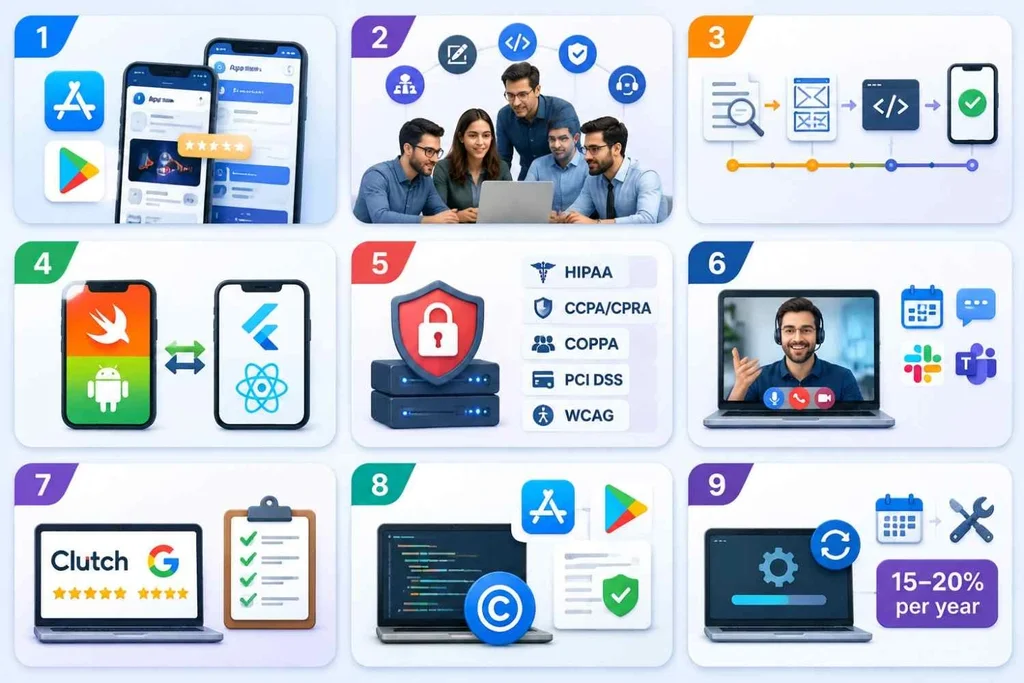
Work through these checks in order. Weak vendors tend to fail by the third or fourth one.
1. Relevant, Live Work (Not Just Pretty Screens)
A portfolio full of polished mockups proves very little. Ask for apps that are live in the App Store or Google Play, and download them yourself.
• Check the star rating, and read the one-star and two-star reviews.
• See how recently the app was updated.
• Test the features you care about, such as login, payments, or push notifications.
• Ask which parts the agency built and which parts the client's team built.
Experience in your category matters more than a long client list. A team that has shipped a booking app already understands scheduling edge cases that a team focused on games may never have faced.
2. Who Will Actually Build Your App
You are hiring a team, not a logo. Ask for names and roles. Will you get a project manager, a designer, mobile developers, a backend developer, and a QA tester? Are they dedicated to your project, or shared across ten other clients?
Also ask whether the people on the sales call will stay involved after you sign. A common pattern is senior people selling the project and junior people building it.
3. A Clear Discovery and Delivery Process
Good agencies start with questions, not code. Look for a short discovery phase that covers user flows, wireframes, and technical planning before development begins.
Then ask how the build runs. Sprint-based delivery, with working builds you can install on your own phone every couple of weeks, is the healthy pattern. If you only see progress at the very end, risk builds up unseen.
4. A Sound Technical Approach
You do not need to be an engineer, but you should understand the main options on the table.
• Native (Swift for iOS, Kotlin for Android): best for graphics-heavy apps, heavy hardware use such as the camera, Bluetooth, or sensors, and top performance. It costs more because two codebases are built.
• Cross-platform (React Native or Flutter): one codebase for both platforms, so it is usually faster and cheaper. It suits most business apps, marketplaces, and MVPs.
Ask the agency why it recommends one over the other for your product. If the answer is always the same regardless of the project, that agency is selling what it knows, not what you need. Also ask how it designs the backend and APIs, because that is where most scaling problems begin.
5. Security and Compliance Awareness
If your app handles personal or sensitive data, compliance is not optional, and fixing it after launch is expensive. Depending on your product, ask whether the team has worked with:
• HIPAA for health data.
• CCPA and CPRA for the personal information of California residents.
• COPPA if children under 13 may use your app.
• PCI DSS for card payments, which is often handled by using a certified payment provider instead of storing card data yourself.
• Accessibility standards such as WCAG.
Ask about secure login, data encryption, and regular security testing as well. Vague answers here are a warning sign.
6. Communication and Time Zone Fit
Most project problems are communication problems in disguise. Ask who your day-to-day contact will be, how often you will get updates, and which tools the team uses.
Overlap with your business hours matters more than people expect. A team that replies within a few hours keeps decisions moving, while a 12-hour delay on every question can add weeks to a project.
7. Reviews and Real References
Check independent platforms such as Clutch and Google reviews. Then go one step further and ask for two or three past clients you can call. When you speak to them, ask:
• Did the project hit its timeline and budget?
• What went wrong, and how did the team respond?
• Would you hire them again?
• Who owns the code today?
How a team handles a problem tells you more than how it handles a smooth week.
8. Code, IP, and Account Ownership
This is the check most first-time buyers skip, and it causes some of the most painful disputes. Before signing, confirm in writing that:
• You own the source code and all intellectual property after final payment.
• The Apple Developer and Google Play accounts are registered in your company's name, not the agency's.
• You get access to the code repository during the project, not only at the end.
• Third-party licenses and open-source components are documented.
If an agency resists any of these points, walk away. Reputable agencies hand everything over without drama.
9. Post-Launch Support and Maintenance
Launching is the start, not the finish. Apple and Google release major operating system updates every year, and an app that is not maintained can start breaking within months.
Ask what a support plan includes, such as bug fixes, OS compatibility updates, monitoring, and new feature work, and what it costs. As a commonly cited rule of thumb, plan to spend roughly 15 to 20 percent of the original build cost each year on maintenance.
What Full-Service Mobile App Development Services Should Include
A complete offering covers the whole lifecycle, not just coding. When you review mobile app development services, look for these pieces:
• Product discovery and UI/UX design.
• Native or cross-platform development.
• Backend and API development.
• QA and testing on real devices and different OS versions.
• App Store and Google Play submission.
• Post-launch maintenance and updates.
Gaps in this list become your problem later. Store rejections, for example, are a common cause of launch delays, and a team that has been through the review process knows what to prepare. You can see how one team structures the full process on the Canduit mobile app development services page.
Mobile App Development Cost: What to Expect in the US
Cost is where most conversations get confusing, because published ranges vary widely. After comparing several 2026 cost guides from development agencies, a realistic picture for US projects looks like this:
| App type | Typical examples | Estimated cost (US) | Typical timeline |
| Simple app or MVP | One core workflow, basic accounts, push notifications | $15,000 to $60,000 | 2 to 4 months |
| Medium complexity | Booking, marketplace, or e-commerce app with payments and an admin panel | $50,000 to $150,000 | 3 to 6 months |
| Complex or enterprise | Real-time features, multiple user roles, heavy integrations, AI features | $150,000 to $300,000+ | 6 to 12 months |
Treat these as broad market ranges, not quotes. Your real number depends on scope, platforms, integrations, and the team's rates. US-based teams commonly charge roughly $100 to $180 per hour. Nearshore and offshore teams charge less, but you may trade away time zone overlap and day-to-day communication.
What Drives Mobile App Development Cost
• The number of platforms, and whether you go native or cross-platform.
• The number and complexity of features.
• A custom backend, an admin dashboard, and third-party integrations.
• The depth of UI/UX design, including custom animation.
• Compliance and security requirements.
• Hosting and post-launch maintenance.
If you want to understand why quotes for similar projects differ so much, our post on why software pricing varies explains what sits behind the numbers.
Why the Lowest Quote Often Costs the Most
Consider an illustrative example. You receive two quotes for the same booking app. One is $35,000 as a single line item. The other is $62,000, with discovery, design, development, testing, store submission, and 90 days of support listed separately.
The cheaper quote usually leaves something out, often testing, backend work, or support. Those gaps return later as change requests. Always ask for an itemized estimate so you can compare like with like. A transparent team will also explain how costs change if the scope changes.
Pick the Right Pricing Model
| Model | How it works | Best for | Main risk |
| Fixed price | Scope, cost, and timeline are set upfront | Small, well-defined MVPs | Changes cost extra and can cause friction |
| Time and materials | You pay for the hours worked | Evolving or complex products | Costs can drift without tracking |
| Dedicated team | A team works only on your product for a monthly fee | Long-term products | Needs steady direction from you |
| Hybrid | Fixed price for discovery or the core build, flexible after that | Mid-size projects | Needs clear boundaries |
Many growing products start with a fixed-price discovery phase and then move to time and materials. That gives you a real plan before you commit the full budget. A small paid trial task is another low-risk way to see how a team thinks, communicates, and responds to feedback.
Questions to Ask Every Mobile App Development Company
Use this list on every sales call, so you can compare answers side by side.
1. Can I see three live apps similar to mine, and speak with those clients?
2. Who exactly will work on my project, and will they stay on it?
3. What does your discovery phase include, and what do I receive at the end?
4. Why do you recommend native or cross-platform for my product?
5. How do you handle changes in scope once development starts?
6. Can you provide an itemized estimate, including third-party costs?
7. How do you test across devices, OS versions, and weak network conditions?
8. Who owns the source code, and whose name goes on the developer accounts?
9. What happens if I want to move to another developer later?
10. What does post-launch support include, and what does it cost?
Pay attention to how they answer, not only what they say. Clear, specific answers are a good sign. Defensive or vague ones usually are not.
Red Flags to Watch For
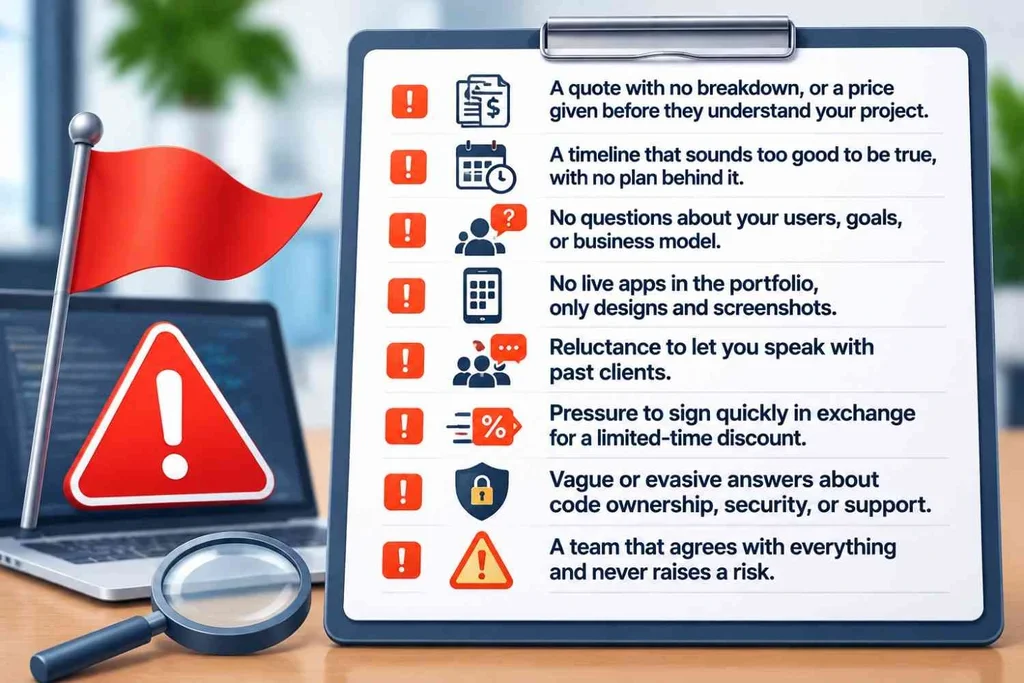
• A quote with no breakdown, or a price given before they understand your project.
• A timeline that sounds too good to be true, with no plan behind it.
• No questions about your users, goals, or business model.
• No live apps in the portfolio, only designs and screenshots.
• Reluctance to let you speak with past clients.
• Pressure to sign quickly in exchange for a limited-time discount.
• Vague or evasive answers about code ownership, security, or support.
• A team that agrees with everything and never raises a risk.
Compare Your Shortlist With a Simple Scorecard
Gut feeling is a poor way to compare three polished proposals. Score each company from 1 to 5 on the criteria below, multiply each score by its weight, and compare the totals. Adjust the weights to fit your project.
| Criteria | Suggested weight |
| Relevant live work | 25% |
| Team quality and dedicated staffing | 15% |
| Process and communication | 15% |
| Technical approach and security | 15% |
| Cost transparency | 10% |
| References and reviews | 10% |
| Ownership terms and post-launch support | 10% |
If two companies score within a few points of each other, choose the team you would rather work with every week. You will be talking to them a lot.
Conclusion: Choose a Partner, Not Just a Price
Choosing a mobile app development company comes down to evidence. Look at live apps, talk to past clients, insist on itemized costs, and get ownership and support terms in writing. Do that, and you remove most of the risk before a single line of code is written.
You can start today. Write the one-page brief, shortlist three companies, and run each one through the scorecard above. A week of careful evaluation can save months of rework and a lot of money.
If you would like a second opinion on your idea, or an estimate based on a written scope, Canduit offers a free consultation. You can get in touch with the Canduit team to talk through your project.
Frequently Asked Questions
How do I choose a mobile app development company?
Start by defining your goals, features, and budget range. Shortlist three to five companies with live apps in your category, then check reviews, speak with past clients, and compare itemized estimates. Finally, confirm in writing that you will own the source code and developer accounts, and that post-launch support is included or clearly priced.
How much does mobile app development cost in the US?
Most US projects fall between about $15,000 for a simple app and $300,000 or more for a complex platform. Medium-complexity apps typically land between $50,000 and $150,000. The final cost depends on features, platforms, integrations, and the team's hourly rates, so ask for an itemized estimate based on a written scope.
Should I choose native or cross-platform development?
Choose native development (Swift and Kotlin) for graphics-heavy apps or apps that rely on deep hardware features. Choose cross-platform development (React Native or Flutter) when speed to market and budget matter most and your app does not need advanced device-specific features. A good agency will explain the trade-offs for your product instead of defaulting to one option.
Is it better to hire a freelancer or a mobile app development company?
Freelancers work well for small, well-defined projects and prototypes. For apps that need design, backend development, testing, security, and ongoing support, a company is usually safer because the work does not depend on one person. Whichever you choose, apply the same checks for live work, references, and code ownership.
What should a mobile app development contract include?
At a minimum, look for a detailed scope and deliverables list, payment milestones, a timeline, a change-request process, transfer of source code and intellectual property, developer accounts in your name, confidentiality terms, and post-launch support terms. Have a qualified attorney review the contract before you sign.