Best AI for Data Integration in the Tech Industry: 10 Platforms Compared
Learn how the leading AI data integration tools compare and how to choose the right platform for your stack, team size, and budget.
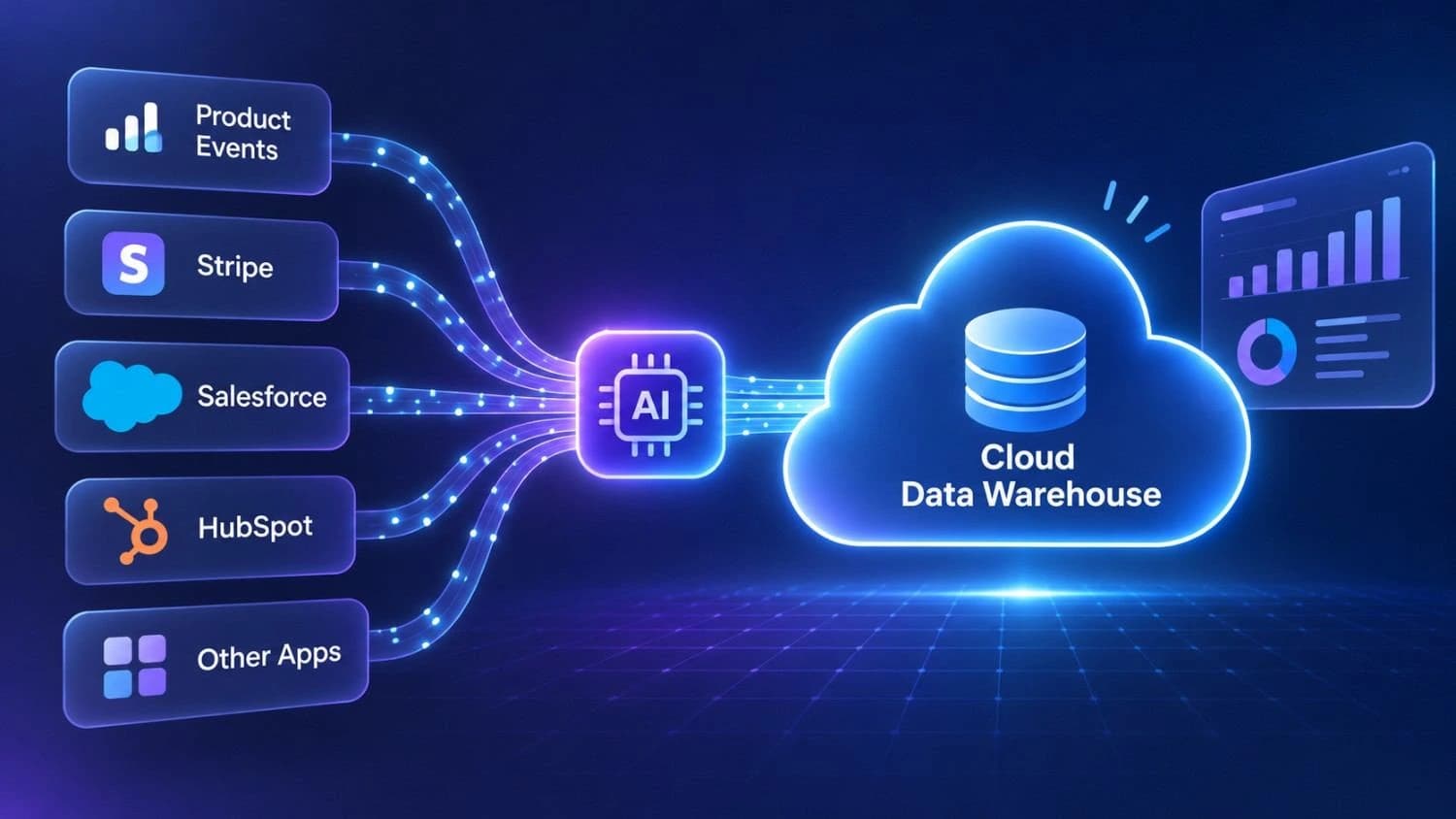
Most tech companies don't have a data shortage. They have a data plumbing problem. Product events sit in one place, billing data lives in Stripe, customer records are split between Salesforce and HubSpot, and engineers keep writing one-off scripts to tie it all together. Every new SaaS tool adds another pipeline someone has to maintain.
That's why so many teams are searching for the best AI for data integration in the tech industry. The right platform can map schemas for you, catch broken pipelines before dashboards go wrong, and even generate transformation logic from a plain-English request. The wrong one adds cost and complexity without fixing the real bottleneck.
In this guide, we compare 10 AI-powered data integration platforms widely used by US tech companies. You'll see what their AI features actually do, where each tool fits, and how to run a short proof of concept so you can choose with confidence instead of relying on vendor demos.
What Is AI Data Integration?
Data integration is the process of moving data from many sources into a usable, consistent form. Traditionally, that meant engineers writing ETL (extract, transform, load) code by hand, then fixing it every time an API or schema changed.
AI data integration tools add machine learning and generative AI to that process. In practice, the AI usually helps in six areas:
• Schema mapping: suggesting how fields in one system match fields in another.
• Pipeline generation: building jobs or SQL from a natural language prompt.
• Schema drift handling: adapting automatically when a source adds or renames columns.
• Data quality checks: flagging anomalies, duplicates, and unexpected nulls.
• Monitoring and troubleshooting: explaining why a job failed and suggesting fixes.
• Metadata and cataloging: classifying data, including sensitive fields like PII.
One honest note: "AI" means very different things across vendors. Some tools have used machine learning for mapping and data quality for years. Others have recently added a chat assistant on top of an existing product. When you evaluate a platform, ask which specific tasks the AI performs and test those tasks yourself.
Why Tech Companies Need AI-Powered Data Integration Platforms
Tech companies face integration pressure from several directions at once. Here's what usually pushes teams to look for better tooling:
• SaaS sprawl. A typical mid-size software company runs dozens of business apps, and each one is a potential data source.
• Real-time expectations. Product, sales, and support teams want fresh data, not yesterday's batch.
• AI and ML workloads. Models, analytics, and retrieval-augmented generation (RAG) apps are only as reliable as the data feeding them.
• Lean data teams. Many companies have two or three data engineers supporting the whole business.
Consider a common scenario. A 200-person SaaS company wants a single view of customer health that combines product usage, support tickets, and billing. Without automation, an engineer might spend weeks building connectors and then several hours a week maintaining them. With a managed, automated data integration solution, the connectors already exist, schema changes are handled automatically, and the engineer can focus on modeling the data instead of babysitting pipelines.
Quick Comparison: Top AI Data Integration Tools in 2026
Use this table as a starting point. Pricing details change often, so confirm current terms directly with each vendor.
| Platform | Best For | Standout AI Capability | Pricing Model |
| Informatica IDMC | Large, governed enterprises | CLAIRE AI mapping, data quality, CLAIRE GPT | Consumption (processing units) |
| Fivetran | Warehouse ELT with minimal upkeep | Automated schema drift handling | Monthly active rows |
| Matillion | Cloud warehouse transformations | Maia AI agent for pipeline building | Credits |
| Boomi | App-to-app integration | Boomi Suggest mapping recommendations | Tiered or custom |
| MuleSoft | API-led, Salesforce-heavy stacks | AI-generated flows and API specs | Custom contract |
| Microsoft Fabric Data Factory | Azure and Power BI users | Copilot for pipelines and dataflows | Fabric capacity |
| AWS Glue | AWS-native engineering teams | Amazon Q ETL generation, zero-ETL | Pay per use (DPU-hours) |
| Google Cloud stack | BigQuery-centered, real-time | Gemini in BigQuery data preparation | Pay per use |
| Airbyte | Startups, custom connectors | AI-assisted Connector Builder | Open source free; cloud usage-based |
| SnapLogic | Low-code app and data integration | SnapGPT and AgentCreator | Custom contract |
The 10 Best AI Data Integration Tools for Tech Teams
Each platform below is a strong option, but they solve different problems. Focus on the ones that match how your data actually moves.
1. Informatica Intelligent Data Management Cloud (IDMC)
Informatica is one of the most established names in enterprise data integration tools, and it became part of Salesforce in 2025. Its CLAIRE AI engine powers automated mapping, data discovery, and data quality recommendations. CLAIRE GPT lets users explore and manage data using natural language.
Best for: large enterprises that need integration, data quality, master data management, and governance in one platform.
Keep in mind: it is powerful but complex. Smaller teams may find it more than they need, and consumption-based pricing requires careful monitoring.
2. Fivetran
Fivetran is the go-to managed ELT service for many tech companies. It offers hundreds of prebuilt connectors that load data into warehouses such as Snowflake, BigQuery, Databricks, and Redshift. Its main strength is automation: it handles schema drift and API changes so your team doesn't have to. In 2025, Fivetran also announced a merger with dbt Labs, which brings ingestion and transformation closer together.
Best for: analytics teams that want reliable, low-maintenance pipelines into a cloud warehouse.
Keep in mind: pricing is based on monthly active rows, so high-volume or frequently updated tables can become expensive. Model your usage before committing.
3. Matillion
Matillion's Data Productivity Cloud is built for cloud data warehouses and pushes transformations down to the warehouse itself. Its AI capabilities, including its agentic assistant Maia, can help build and document pipelines from natural language instructions.
Best for: data engineering teams that want visual pipeline building plus AI help, without giving up control over transformations.
Keep in mind: it works best when your stack is centered on a major cloud warehouse.
4. Boomi
Boomi is an integration platform as a service (iPaaS) focused on connecting applications, not just loading warehouses. Boomi Suggest uses anonymized metadata from its large user community to recommend field mappings, and the company has expanded into AI agent management.
Best for: IT teams connecting business apps like ERP, CRM, and HR systems in near real time.
Keep in mind: it is less specialized for heavy analytics ELT than warehouse-focused tools.
5. MuleSoft Anypoint Platform
MuleSoft, owned by Salesforce, is built around API-led connectivity. Its AI features help developers generate integration flows and API specifications from natural language inside its development tools.
Best for: companies with complex API ecosystems or heavy Salesforce usage.
Keep in mind: it typically requires skilled developers and sits at the higher end of the pricing spectrum.
6. Microsoft Fabric Data Factory
Data Factory in Microsoft Fabric combines data pipelines and dataflows in one SaaS experience. Copilot can help create transformations and pipelines from plain-English prompts, and everything ties into OneLake and Power BI.
Best for: organizations already invested in Azure, Microsoft 365, and Power BI.
Keep in mind: the value drops if most of your data and tools live outside the Microsoft ecosystem.
7. AWS Glue
AWS Glue is a serverless data integration service. Amazon Q can generate Glue ETL jobs from natural language, and AWS has expanded zero-ETL integrations that replicate data between services like Aurora and Redshift without building pipelines.
Best for: engineering teams running mostly on AWS who are comfortable with code.
Keep in mind: it is less beginner-friendly than managed connector tools, and third-party SaaS connectors are not its core strength.
8. Google Cloud (BigQuery, Datastream, and Dataflow with Gemini)
Google Cloud doesn't offer one single integration product. Instead, teams combine Datastream for change data capture, Dataflow for streaming and batch processing, and BigQuery for storage and transformation. Gemini in BigQuery assists with data preparation, SQL generation, and cleaning suggestions.
Best for: teams already standardized on BigQuery that need real-time pipelines.
Keep in mind: assembling several services takes more engineering effort than an all-in-one tool.
9. Airbyte
Airbyte is an open-source data movement platform with hundreds of connectors and an active community. Its AI-assisted Connector Builder can help create custom connectors from API documentation, which is useful for niche tools that commercial vendors don't support. It also supports loading unstructured data into vector databases for AI applications.
Best for: cost-conscious teams, startups, and companies that need custom connectors or self-hosting.
Keep in mind: community connectors vary in maturity, and self-hosting means your team owns the infrastructure.
10. SnapLogic
SnapLogic is a low-code iPaaS that covers both application and data integration. SnapGPT lets users describe a pipeline in plain language and generates it, while AgentCreator supports building AI agents that work with enterprise data.
Best for: mid-market and enterprise teams that want one platform for app and data integration with low-code tooling.
Keep in mind: like most enterprise iPaaS tools, pricing is usually custom, so get detailed quotes early.
How to Choose the Best Data Integration Software
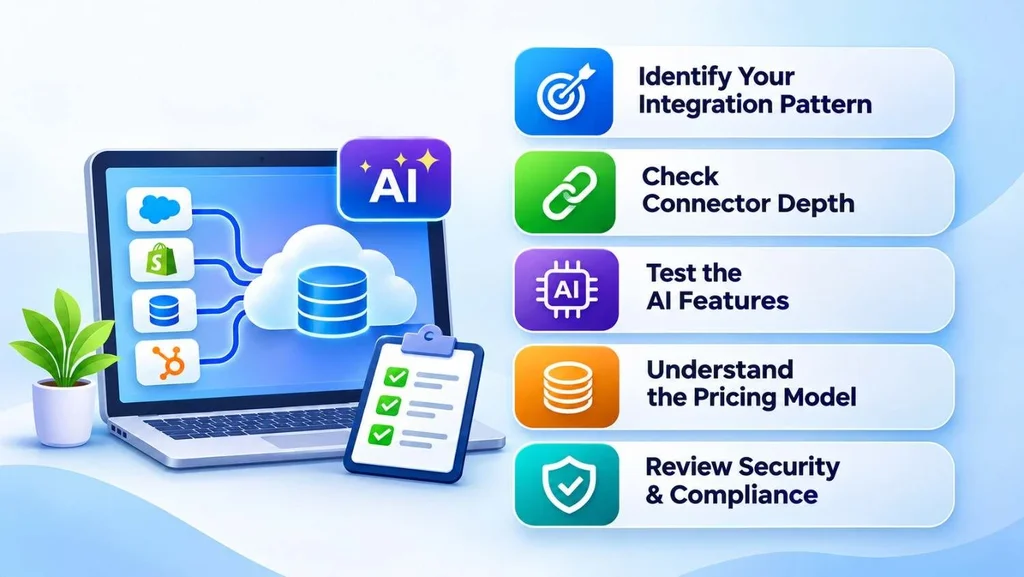
There is no single best platform for every company. The best choice depends on how your data moves and who maintains it. Work through these factors in order.
Identify Your Main Integration Pattern
Most needs fall into three patterns. Analytics ELT moves SaaS and database data into a warehouse (Fivetran, Airbyte, Matillion). Application integration syncs data between operational apps (Boomi, MuleSoft, SnapLogic). Real-time replication uses change data capture for live data (Datastream, zero-ETL, and CDC connectors). Pick a tool built for your dominant pattern.
Check Connector Depth, Not Just Count
A vendor may advertise hundreds of connectors, but what matters is how well they support the five or ten sources you actually use. Check whether each connector supports incremental syncs, deletes, custom fields, and historical backfills.
Test the AI Features on Real Tasks
Give the AI assistant a real job, such as mapping your CRM fields to your warehouse model or explaining a failed sync. Judge it on accuracy and time saved, not on how impressive the demo looks.
Understand the Pricing Model
Pricing models vary widely: monthly active rows, credits, processing units, capacity, or custom contracts. Estimate your monthly volume, sync frequency, and growth over the next year before comparing quotes.
Review Security and Compliance
US tech companies often need SOC 2 Type II reports, and some also need HIPAA support or CCPA compliance controls. Confirm data residency options, encryption, role-based access, and whether customer data is used to train vendor AI models.
Which Platform Fits Your Company Stage?
Company size changes the right answer more than most comparison articles admit. Here's a practical way to narrow the field:
• Early-stage startups: Airbyte (open source or cloud) or the free tiers of managed tools keep costs low while you learn what you need.
• Growth-stage SaaS companies: Fivetran or Matillion paired with a cloud warehouse usually delivers the fastest time to value.
• Cloud-committed teams: native options like AWS Glue, Microsoft Fabric, or Google Cloud reduce vendor sprawl and may use existing cloud commitments.
• Large or regulated enterprises: Informatica, MuleSoft, or Boomi offer the governance, support, and breadth that complex environments require.
How to Run a 30-Day Proof of Concept
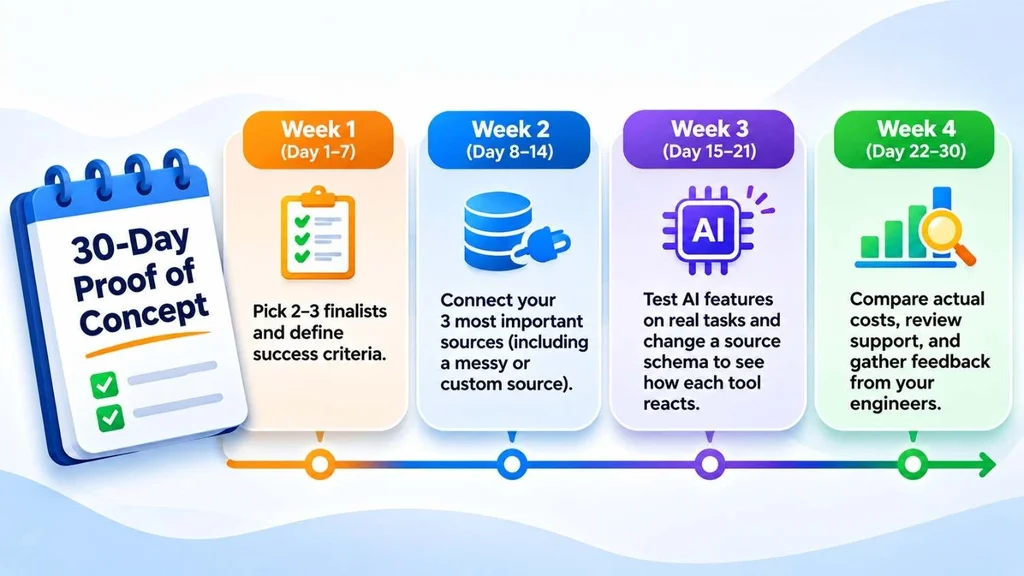
A short, structured trial reveals more than any sales call. Here's a simple plan:
1. Week 1: Pick two or three finalists and define success criteria, such as sync reliability, setup time, and cost per month.
2. Week 2: Connect your three most important sources, including at least one messy or custom source.
3. Week 3: Test AI features on real tasks and deliberately change a source schema to see how each tool reacts.
4. Week 4: Compare actual usage costs, review support responsiveness, and gather feedback from the engineers who used each tool.
Document the results in a simple scorecard. It makes the final decision easier to defend with leadership and finance.
Common Mistakes to Avoid
Even good tools fail when the rollout is rushed. Watch out for these common pitfalls:
• Choosing based on connector count alone. Depth and reliability matter more.
• Ignoring cost at scale. A tool that's cheap in a pilot can become expensive as volumes grow.
• Trusting AI output blindly. Always review generated mappings and transformations before production.
• Skipping data ownership. Assign clear owners for each pipeline so failures don't sit unnoticed.
• Forgetting governance. Integrated data spreads sensitive fields faster, so plan access controls early.
Where AI Data Integration Is Heading
The market is shifting quickly. Three trends are worth watching as you plan for the next few years. First, agentic AI is moving from simple assistants toward agents that can build, monitor, and repair pipelines with human approval. Second, open standards like the Model Context Protocol (MCP) are making it easier for AI agents to access enterprise data sources securely. Third, zero-ETL features from cloud providers are reducing the need for separate pipelines in some use cases.
The takeaway is simple: choose a platform that is investing seriously in AI, but don't pay a premium today for features you can't validate in your own environment.
Conclusion
The best AI for data integration in the tech industry is the one that fits your data patterns, your cloud stack, and your team's skills. Fivetran and Airbyte make warehouse loading simple. Matillion adds strong AI-assisted transformation. Boomi, MuleSoft, and SnapLogic shine at application integration. Informatica leads for governed enterprise data, while AWS Glue, Microsoft Fabric, and Google Cloud make sense when you're already committed to one cloud.
If you're new to this, begin with the basics of getting started with AI data integration. Map your top data sources, shortlist two or three platforms, and run a focused 30-day proof of concept. Test the AI features on real work, model costs at your expected scale, and involve the engineers who will maintain the pipelines. That process will point you to the right tool far more reliably than any ranking.
Frequently Asked Questions
What is the best AI for data integration in the tech industry?
There's no single winner. Fivetran and Airbyte are popular for loading data into warehouses, Informatica leads for enterprise governance, and Boomi or MuleSoft are strong for application integration. The best choice depends on your data sources, cloud platform, and budget.
How do AI data integration tools work?
They use machine learning and generative AI to automate tasks like schema mapping, pipeline creation, error detection, and data quality checks. Many now let users describe a pipeline in plain English and generate the configuration or code automatically.
Are AI-powered data integration platforms secure?
Leading platforms offer encryption, role-based access, and certifications like SOC 2 Type II. Still, you should review each vendor's data handling policies, including whether your data is used to train their AI models, before connecting sensitive systems.
What is the difference between ETL and ELT?
ETL transforms data before loading it into a destination. ELT loads raw data first and transforms it inside the warehouse. Most modern cloud tools favor ELT because cloud warehouses can handle transformations at scale.
Is there free or open-source data integration software?
Yes. Airbyte offers an open-source version you can self-host, and several commercial tools provide free tiers with limited usage. Free options work well for startups, but factor in the engineering time needed to run and maintain them.